

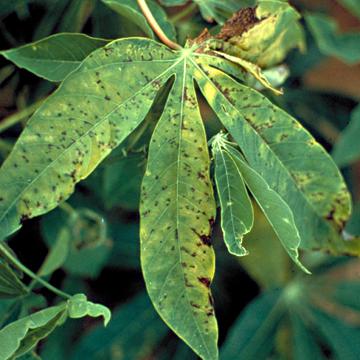
DISEASE: Bacterial leaf spot (Bacterial necrosis)
HOST: Cassava
Cassava with yellowish leaves and water-soaked, angular spots. The disease is primarily on foliage, although the pathogen may invade stem buds and young branches.
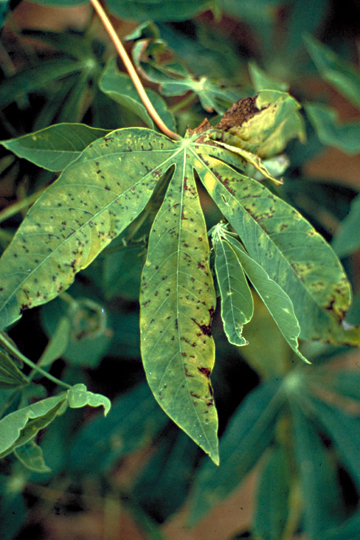
Bacterial leaf spot (Bacterial necrosis) | Cassava
DISEASE: Bacterial leaf spot (Bacterial necrosis)
HOST: Cassava (Manihot esculenta)
PATHOGEN: Xanthomonas cassavae
PATHOGEN SYNONYM: Xanthomonas campestris pv. cassavae
SOURCE: APS
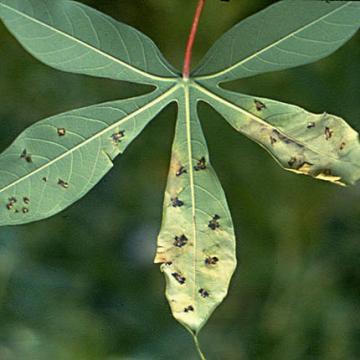
DISEASE: Bacterial leaf spot (Bacterial necrosis)
HOST: Cassava
Cassava with brownish lesions and blackish edges. Leaves turn yellow with multiple infection sites.
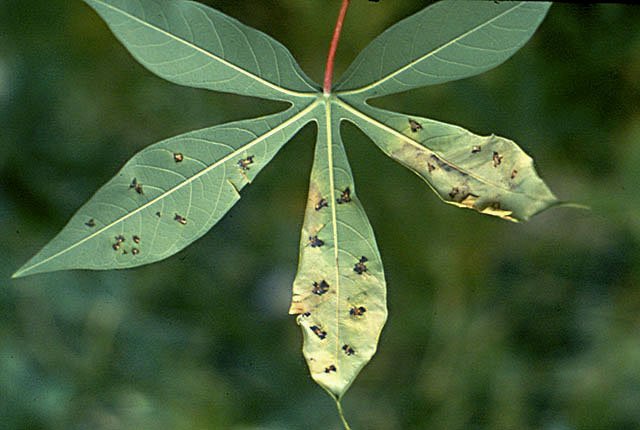
Bacterial leaf spot (Bacterial necrosis) | Cassava
DISEASE: Bacterial leaf spot (Bacterial necrosis)
HOST: Cassava (Manihot esculenta)
PATHOGEN: Xanthomonas cassavae
PATHOGEN SYNONYM: Xanthomonas campestris pv. cassavae
SOURCE: H. Maraite, A. Alvarez
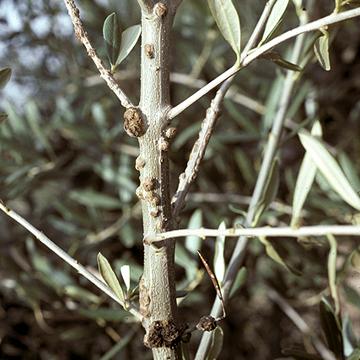
DISEASE: Olive knot
HOST: Olive
Multiple infections of young stems. The bacterium invades vascular tissues during certain times of the year and may be isolated from branches that appear healthy.
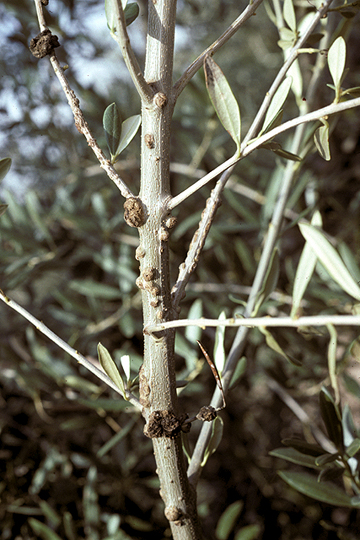
Olive knot | Olive
DISEASE: Olive knot
HOST: Olive (Olea europaea)
PATHOGEN: Pseudomonas savastanoi pv. savastanoi
SOURCE: M. Schroth
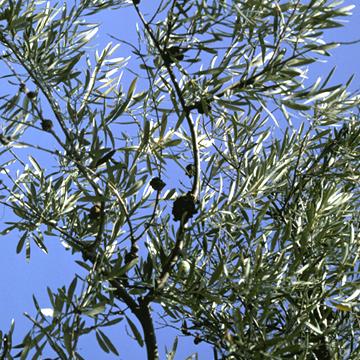
DISEASE: Olive knot
HOST: Olive
Tree with knots/galls on branches along with twig dieback, which is associated with knots. Fusarium and Diplodia spp. infect through knots and are thought to be main reason for dieback.
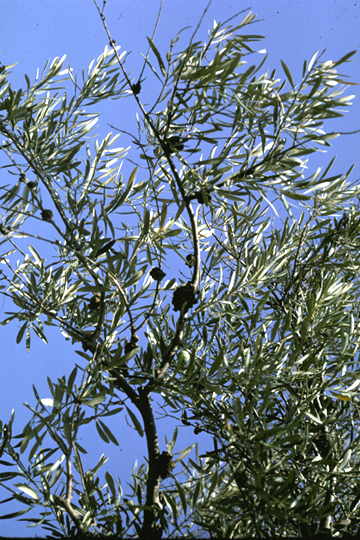
Olive knot | Olive
DISEASE: Olive knot
HOST: Olive (Olea europaea)
PATHOGEN: Pseudomonas savastanoi pv. savastanoi
SOURCE: M. Schroth
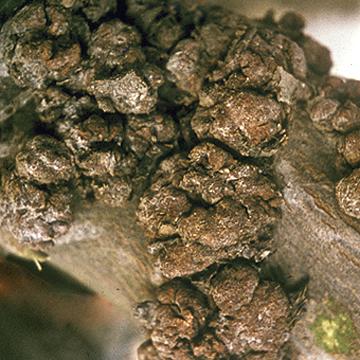
DISEASE: Olive knot
HOST: Olive
Multiple infections on olive branch. Knots at this stage begin to die from the outside in and are infected by several fungi.
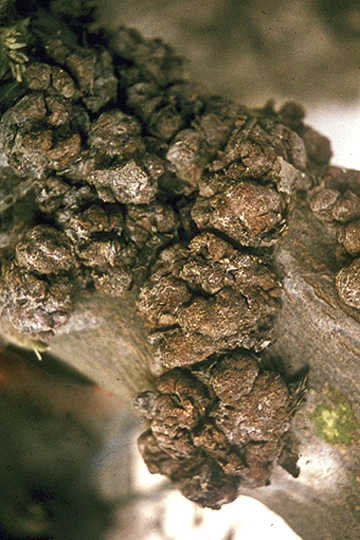
Olive knot | Olive
DISEASE: Olive knot
HOST: Olive (Olea europaea)
PATHOGEN: Pseudomonas savastanoi pv. savastanoi
SOURCE: M. Schroth
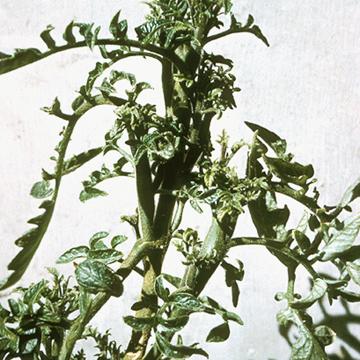
DISEASE: Tomato big bud
HOST: Tomato
Characteristic symptoms are swollen, apical stems and stunted leaves. Apical stems are generally thickened and assume a stiff and erect growth habit. Internodes are shortened and flower buds are greatly enlarged.
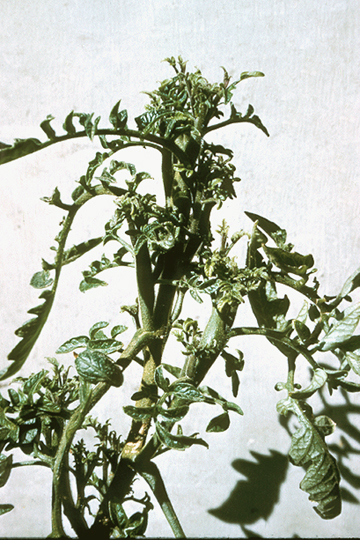
Tomato big bud | Tomato
DISEASE: Tomato big bud
HOST: Tomato (Lycopersicon esculentum)
PATHOGEN: 'Candidatus Phytoplasma asteris'
PATHOGEN SYNONYM: Phytoplasma Aster yellows group
SOURCE: D. Teakle
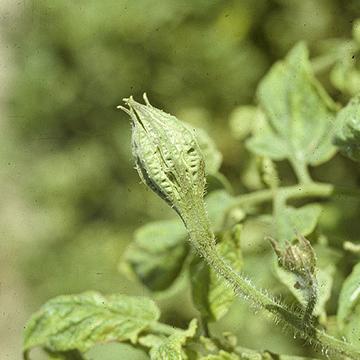
DISEASE: Tomato big bud
HOST: Tomato
Symptoms are enlarge sepals that do not separate. Flower buds stay green and do not develop into fruit. Leaves are small and chlorotic.
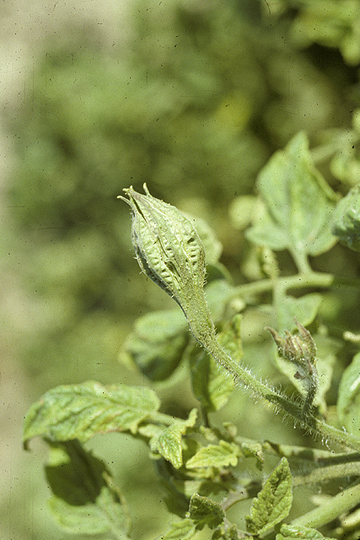
Tomato big bud | Tomato
DISEASE: Tomato big bud
HOST: Tomato (Lycopersicon esculentum)
PATHOGEN: 'Candidatus Phytoplasma asteris'
PATHOGEN SYNONYM: Phytoplasma Aster yellows group
SOURCE: S. Thomson
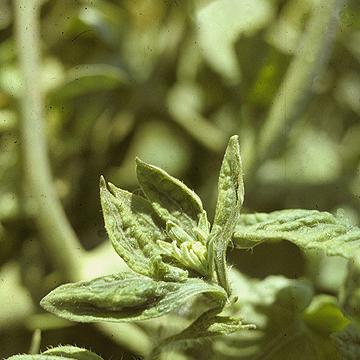
DISEASE: Tomato big bud
HOST: Tomato
Abnormal flower bud with greatly enlarged sepals. Sepals do not separate, fruit is not produced, and apical growth is upright.
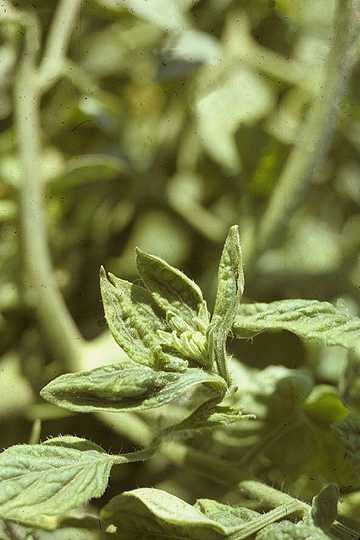
Tomato big bud | Tomato
DISEASE: Tomato big bud
HOST: Tomato (Lycopersicon esculentum)
PATHOGEN: 'Candidatus Phytoplasma asteris'
PATHOGEN SYNONYM: Phytoplasma Aster yellows group
SOURCE: S. Thomson
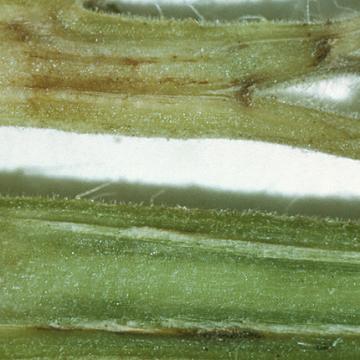
DISEASE: Tomato big bud
HOST: Tomato
Sliced stems with phloem necrosis and brown discoloration.
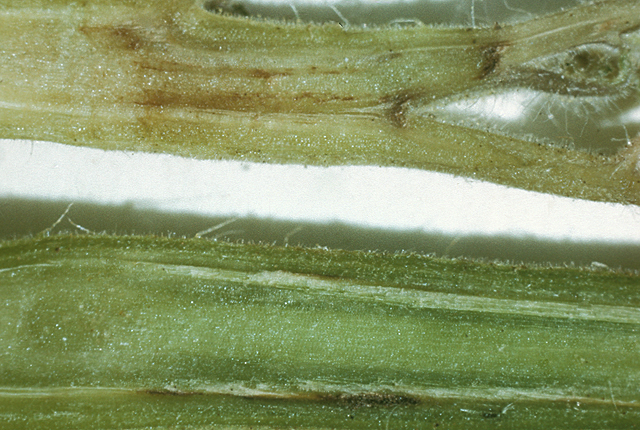
Tomato big bud | Tomato
DISEASE: Tomato big bud
HOST: Tomato (Lycopersicon esculentum)
PATHOGEN: 'Candidatus Phytoplasma asteris'
PATHOGEN SYNONYM: Phytoplasma Aster yellows group
SOURCE: D. Teakle