

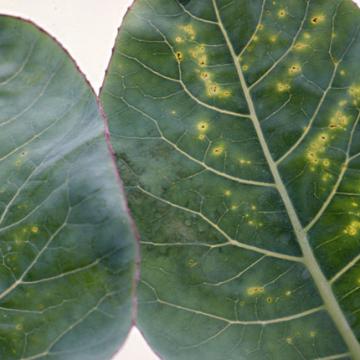
DISEASE: Bacterial leaf spot (Head rot)
HOST: Cauliflower
Leaves with tiny lesions surrounded by large halos.
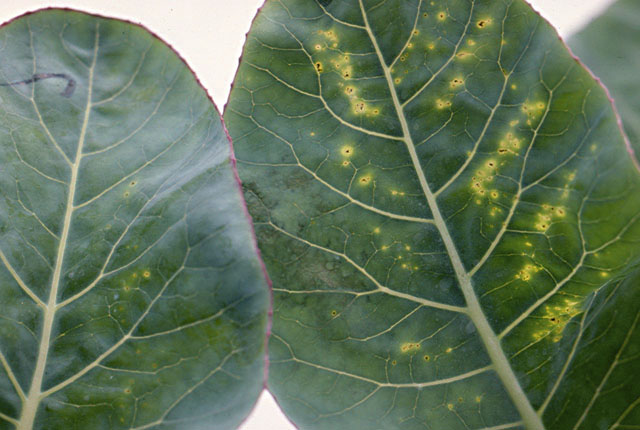
Bacterial leaf spot (Head rot) | Cauliflower
DISEASE: Bacterial leaf spot (Head rot)
HOST: Cauliflower (Brassica oleracea var. botrytis)
PATHOGEN: Pseudomonas syringae pv. maculicola
SOURCE: R. Campbell
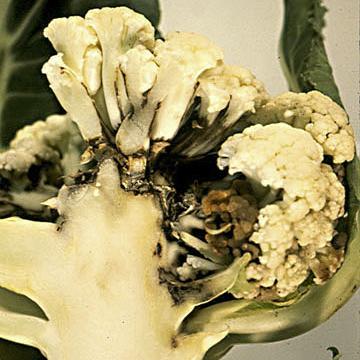
DISEASE: Bacterial leaf spot (Head rot)
HOST: Cauliflower
Section of a cauliflower head with discolored, infected tissues.
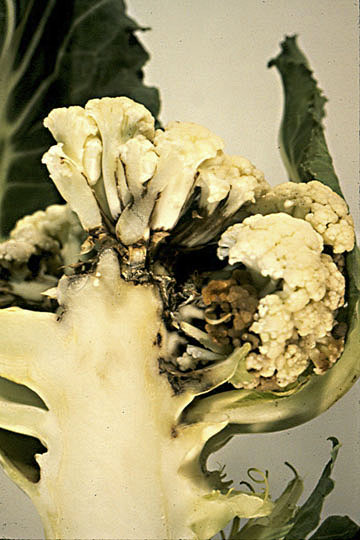
Bacterial leaf spot (Head rot) | Cauliflower
DISEASE: Bacterial leaf spot (Head rot)
HOST: Cauliflower (Brassica oleracea var. botrytis)
PATHOGEN: Pseudomonas syringae pv. maculicola
SOURCE: R. Campbell
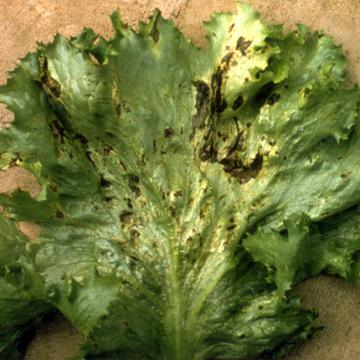
DISEASE: Bacterial leaf spot (Head rot)
HOST: Lettuce
Leaf with black, greasy spots that tend to be vein delimited. Lesions begin as small, angular, water-soaked lesions that coalesce, resulting in large necrotic areas.
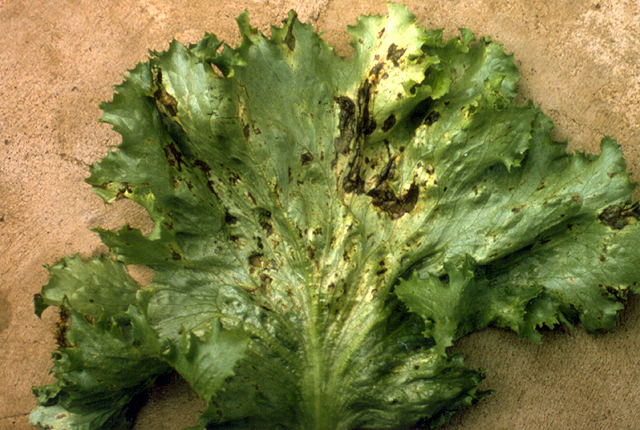
Bacterial leaf spot (Head rot) | Lettuce
DISEASE: Bacterial leaf spot (Head rot)
HOST: Lettuce (Lactuca sativa)
PATHOGEN: Xanthomonas axonopodis pv. vitians
PATHOGEN SYNONYM: Xanthomonas campestris pv. vitians
SOURCE: A. Alvarez
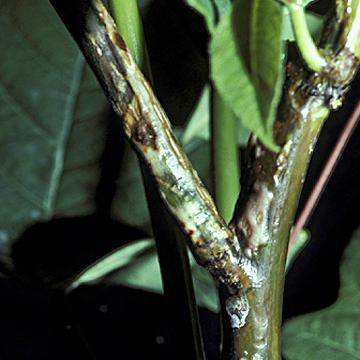
DISEASE: Greasy center
HOST: Poinsettia
Stem with dark cankers and copious ooze. Necrotic areas are greasy in appearance and eventually turn light tan to brown with a papery texture as the cuticle becomes detached.
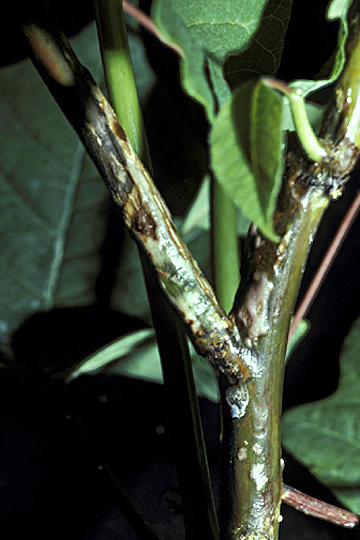
Greasy center | Poinsettia
DISEASE: Greasy center
HOST: Poinsettia (Euphorbia pulcherrima)
PATHOGEN: Pseudomonas viridiflava
SOURCE: R. Raabe
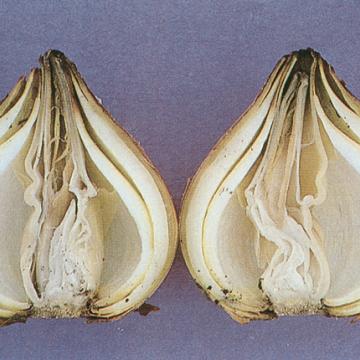
DISEASE: Slippery skin
HOST: Onion
Rot progresses from the top of infected scales and eventually internal tissues rot. In early stages, the only external symptoms may be softening of the neck.
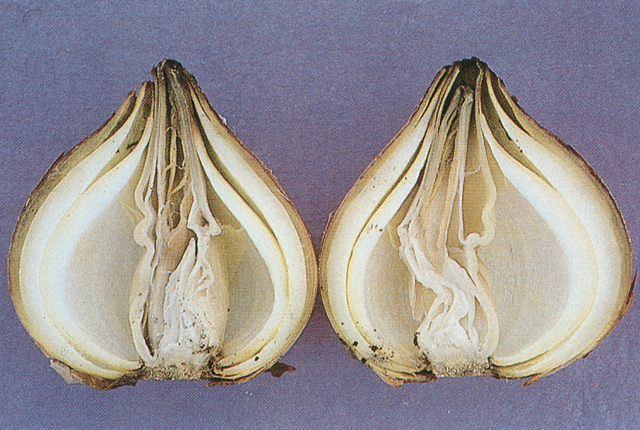
Slippery skin | Onion
DISEASE: Slippery skin
HOST: Onion (Allium cepa)
PATHOGEN: Burkholderia gladioli pv. alliicola
PATHOGEN SYNONYM: Pseudomonas gladioli pv. alliicola
SOURCE: H. Schwartz