

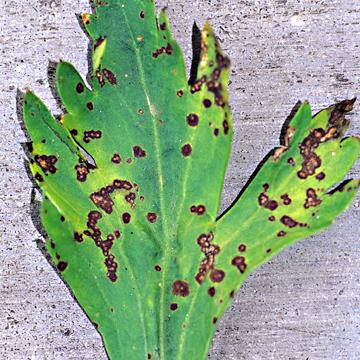
DISEASE: Bacterial blight (Brown stem)
HOST: Celery
Lesions are necrotic and circular to angular. Some have yellowish halos. Older lesions become brown and dry.
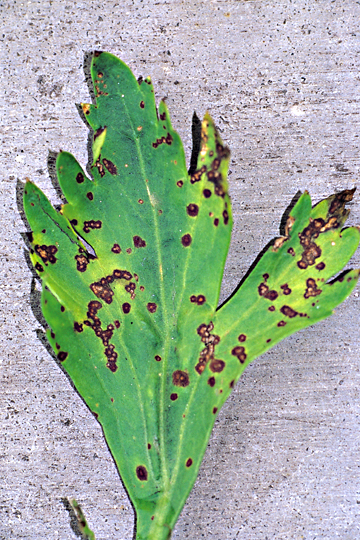
Bacterial blight (Brown stem) | Celery
DISEASE: Bacterial blight (Brown stem)
HOST: Celery (Apium graveolens)
PATHOGEN: Pseudomonas cichorii
SOURCE: R. Raid
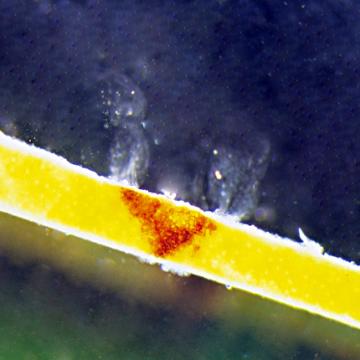
DISEASE: Bacterial blight (Brown stem)
HOST: Celery
Ooze from lesion on celery leaf.
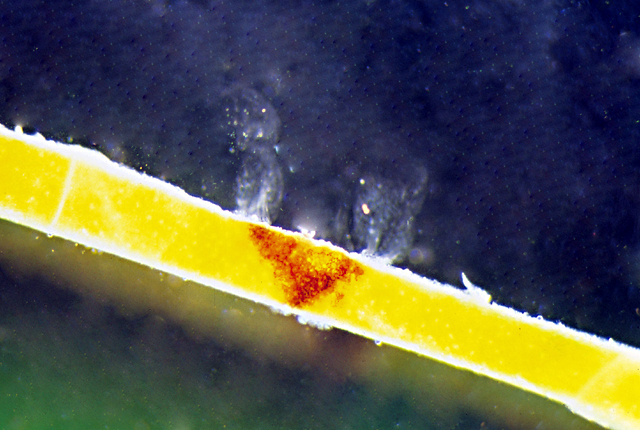
Bacterial blight (Brown stem) | Celery
DISEASE: Bacterial blight (Brown stem)
HOST: Celery (Apium graveolens)
PATHOGEN: Pseudomonas cichorii
SOURCE: R. Raid
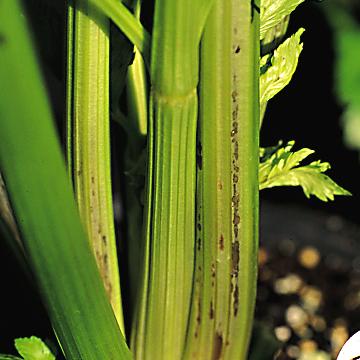
DISEASE: Bacterial blight (Brown stem)
HOST: Celery
Characteristic brown discoloration of petioles, which is more evident on inside of petiole close to the crown. Parenchyma tissues are firm and brown.
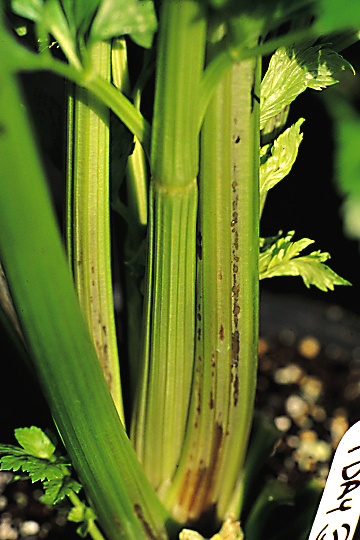
Bacterial blight (Brown stem) | Celery
DISEASE: Bacterial blight (Brown stem)
HOST: Celery (Apium graveolens)
PATHOGEN: Pseudomonas cichorii
SOURCE: K. Pernezny
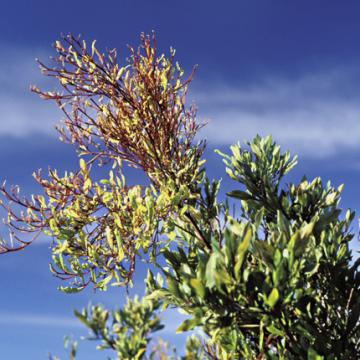
DISEASE: Dodonaea yellows
HOST: Florida hopbush
Hopbush with brownish red witches'-broom.
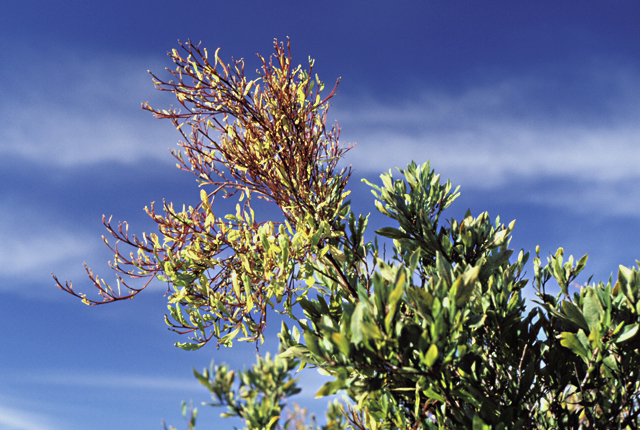
Dodonaea yellows | Florida hopbush
DISEASE: Dodonaea yellows
HOST: Florida hopbush (Dodonaea viscosa)
PATHOGEN: 'Candidatus Phytoplasma pruni'
PATHOGEN SYNONYM: Phytoplasma X-disease group
SOURCE: W. Borth
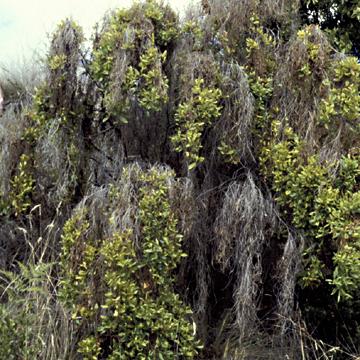
DISEASE: Dodonaea yellows
HOST: Florida hopbush
Advanced stage of dodonaea yellows and witches'-broom.
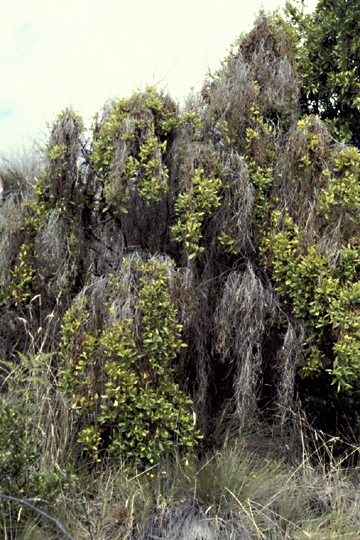
Dodonaea yellows | Florida hopbush
DISEASE: Dodonaea yellows
HOST: Florida hopbush (Dodonaea viscosa)
PATHOGEN: 'Candidatus Phytoplasma pruni'
PATHOGEN SYNONYM: Phytoplasma X-disease group
SOURCE: W. Borth
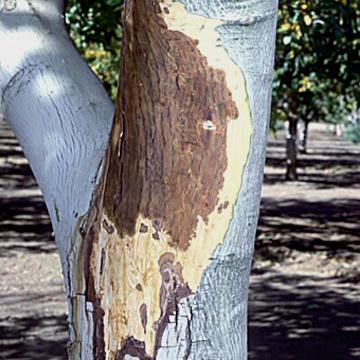
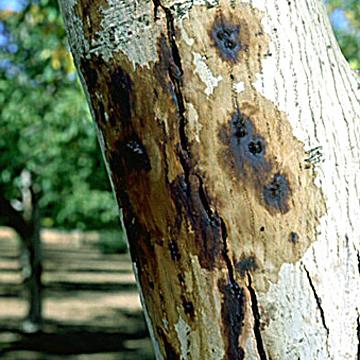
DISEASE: Shallow bark canker
HOST: Walnut
Diseased, discolored tissues revealed by removing external bark.
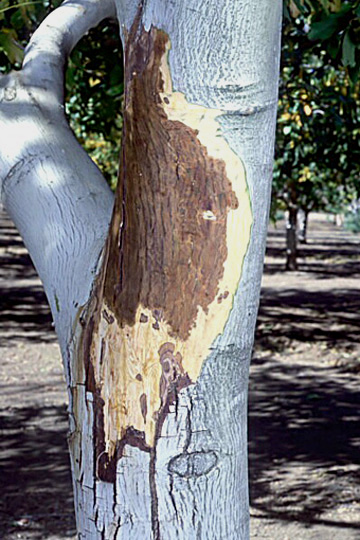
Shallow bark canker | Walnut
DISEASE: Shallow bark canker
HOST: Walnut (Juglans regia 'Hartley')
PATHOGEN: Brenneria nigrifluens
PATHOGEN SYNONYM: Erwinia nigrifluens
SOURCE: B. Teviotdale
DISEASE: Shallow bark canker
HOST: Walnut
Trunk with brown exudate shallow cankers.
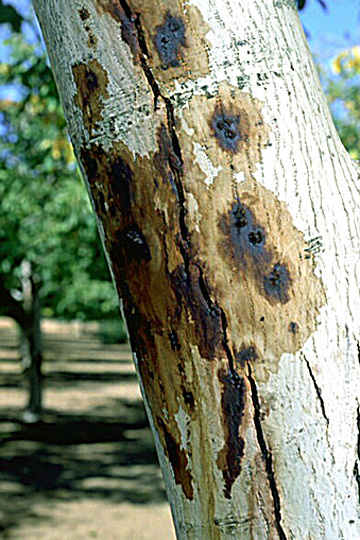
Shallow bark canker | Walnut
DISEASE: Shallow bark canker
HOST: Walnut (Juglans regia 'Hartley')
PATHOGEN: Brenneria nigrifluens
PATHOGEN SYNONYM: Erwinia nigrifluens
SOURCE: B. Teviotdale
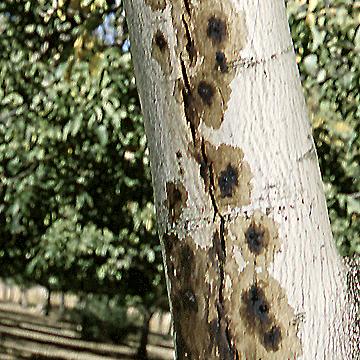
DISEASE: Shallow bark canker
HOST: Walnut
Multiple cankers with brown exudate. Cankers on trunk are shallow.
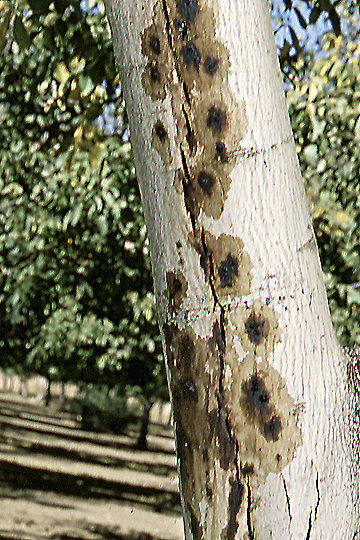
Shallow bark canker | Walnut
DISEASE: Shallow bark canker
HOST: Walnut (Juglans regia 'Hartley')
PATHOGEN: Brenneria nigrifluens
PATHOGEN SYNONYM: Erwinia nigrifluens
SOURCE: B. Teviotdale