

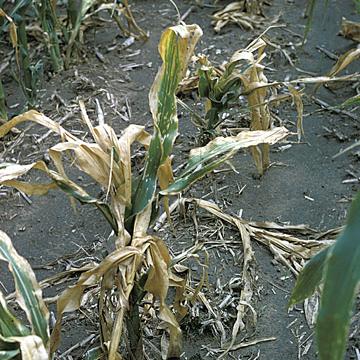
DISEASE: Goss's bacterial wilt and blight
HOST: Corn (Maize)
Wilted, dying plants. Leaves have gray to light yellow stripes and irregular margins that follow leaf veins. Systemically infected plants usually have orange vascular bundles.
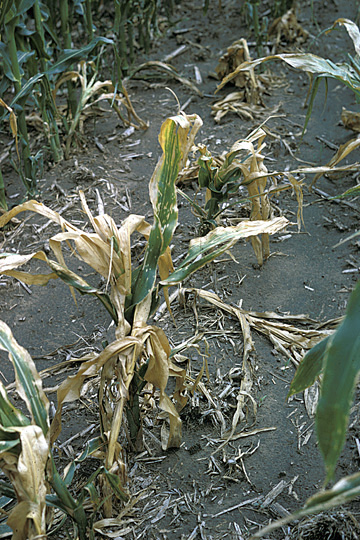
Goss's bacterial wilt and blight | Corn (Maize)
DISEASE: Goss's bacterial wilt and blight
HOST: Corn (Maize) (Zea mays)
PATHOGEN: Clavibacter michiganensis subsp. nebraskensis
PATHOGEN SYNONYM: Corynebacterium nebraskense
SOURCE: A. Vidaver
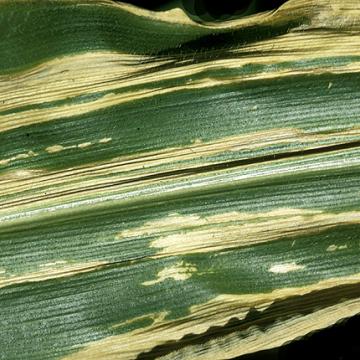
DISEASE: Goss's bacterial wilt and blight
HOST: Corn (Maize)
The disease causes necrotic leaf lesions, which typically have dark flecks (freckles) within the lesions (not seen here).
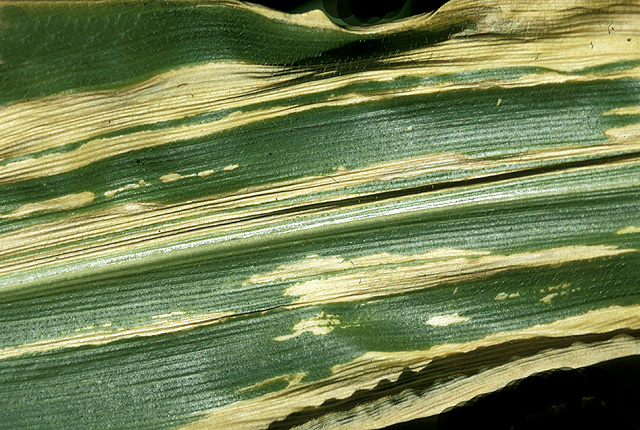
Goss's bacterial wilt and blight | Corn (Maize)
DISEASE: Goss's bacterial wilt and blight
HOST: Corn (Maize) (Zea mays)
PATHOGEN: Clavibacter michiganensis subsp. nebraskensis
PATHOGEN SYNONYM: Corynebacterium nebraskense
SOURCE: A. Vidaver
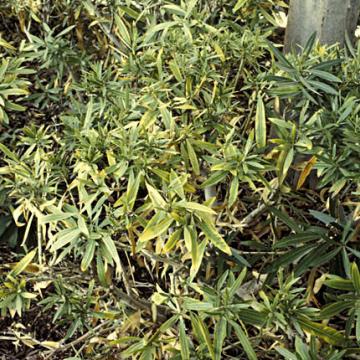
DISEASE: Oleander leaf scorch
HOST: Oleander
Diseased plant with scalloped, yellowish leaves. This usually is followed by dieback of twigs and branches. Plants often die 2 years after infection.
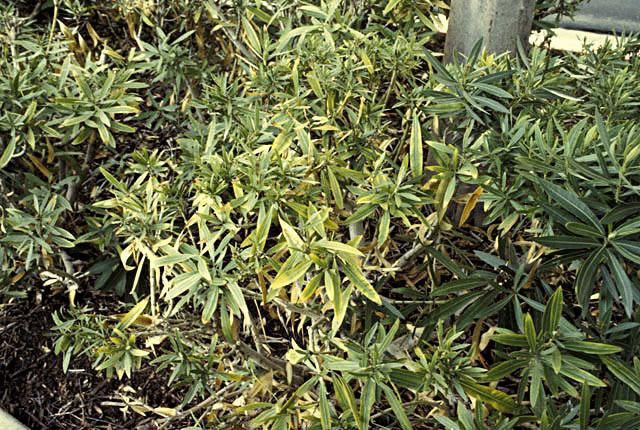
Oleander leaf scorch | Oleander
DISEASE: Oleander leaf scorch
HOST: Oleander (Nerium oleander)
PATHOGEN: Xylella fastidiosa
SOURCE: S. Purcell
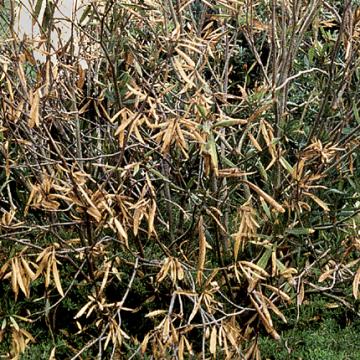
DISEASE: Oleander leaf scorch
HOST: Oleander
Oleander with symptoms of severe scorch.
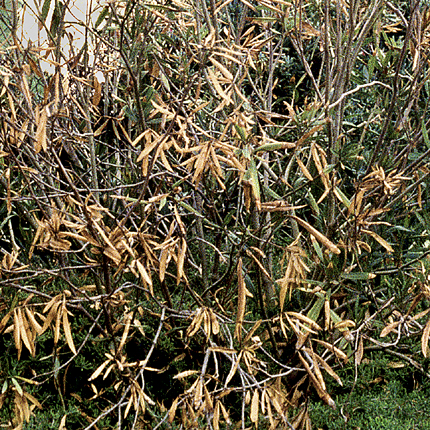
Oleander leaf scorch | Oleander
DISEASE: Oleander leaf scorch
HOST: Oleander (Nerium oleander)
PATHOGEN: Xylella fastidiosa
SOURCE: M. Blua
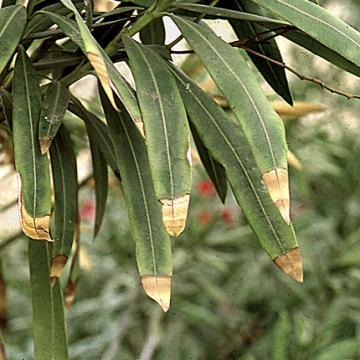
DISEASE: Oleander leaf scorch
HOST: Oleander
Oleander with scorch symptoms primarily at leaf tips, an early stage of disease.
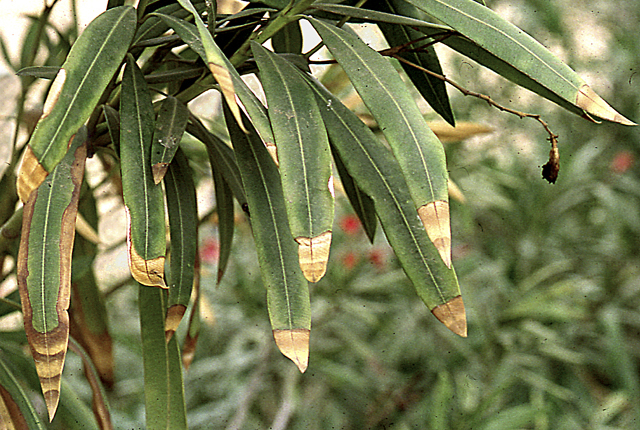
Oleander leaf scorch | Oleander
DISEASE: Oleander leaf scorch
HOST: Oleander (Nerium oleander)
PATHOGEN: Xylella fastidiosa
SOURCE: M. Blua
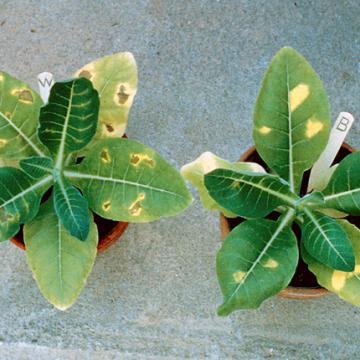
DISEASE: Wildfire (Angular leaf spot)
HOST: Tobacco
Characteristic symptoms are necrotic, brown spots with angular margins surrounded by distinct yellow halos. The halos are caused by the production of tabtoxin.
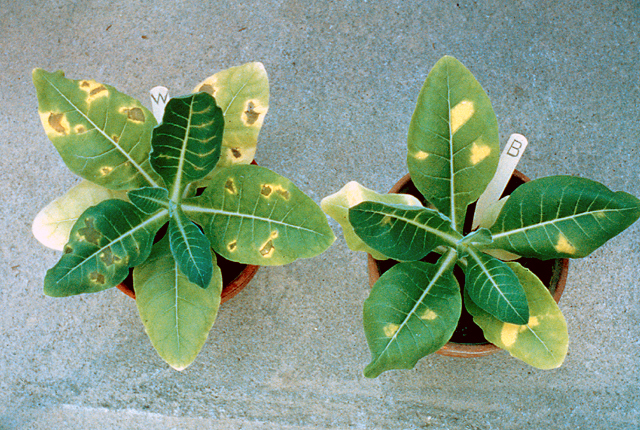
Wildfire (Angular leaf spot) | Tobacco
DISEASE: Wildfire (Angular leaf spot)
HOST: Tobacco (Nicotiana tabacum)
PATHOGEN: Pseudomonas syringae pv. tabaci
SOURCE: G. Lucas