

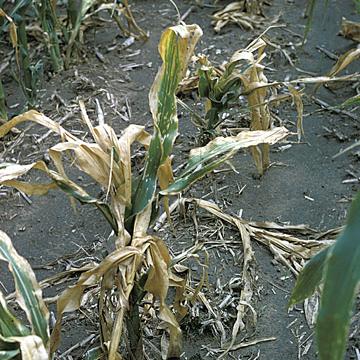
DISEASE: Goss's bacterial wilt and blight
HOST: Corn (Maize)
Wilted, dying plants. Leaves have gray to light yellow stripes and irregular margins that follow leaf veins. Systemically infected plants usually have orange vascular bundles.
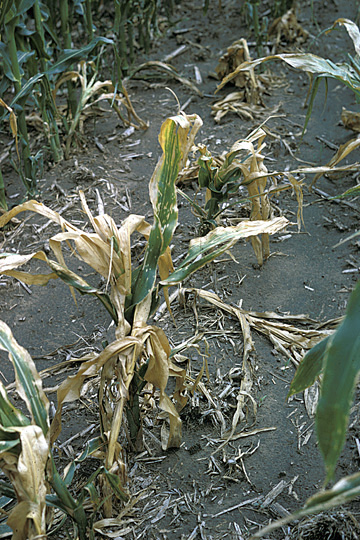
Goss's bacterial wilt and blight | Corn (Maize)
DISEASE: Goss's bacterial wilt and blight
HOST: Corn (Maize) (Zea mays)
PATHOGEN: Clavibacter michiganensis subsp. nebraskensis
PATHOGEN SYNONYM: Corynebacterium nebraskense
SOURCE: A. Vidaver
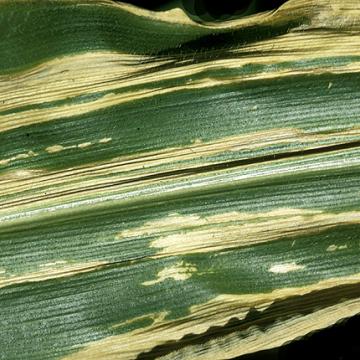
DISEASE: Goss's bacterial wilt and blight
HOST: Corn (Maize)
The disease causes necrotic leaf lesions, which typically have dark flecks (freckles) within the lesions (not seen here).
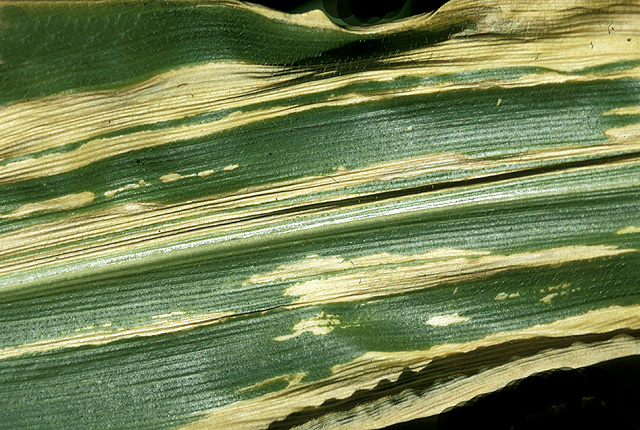
Goss's bacterial wilt and blight | Corn (Maize)
DISEASE: Goss's bacterial wilt and blight
HOST: Corn (Maize) (Zea mays)
PATHOGEN: Clavibacter michiganensis subsp. nebraskensis
PATHOGEN SYNONYM: Corynebacterium nebraskense
SOURCE: A. Vidaver
DISEASE: Sweet potato little leaf
HOST: Sweet potato
Infected plant (left) and healthy plant (right).
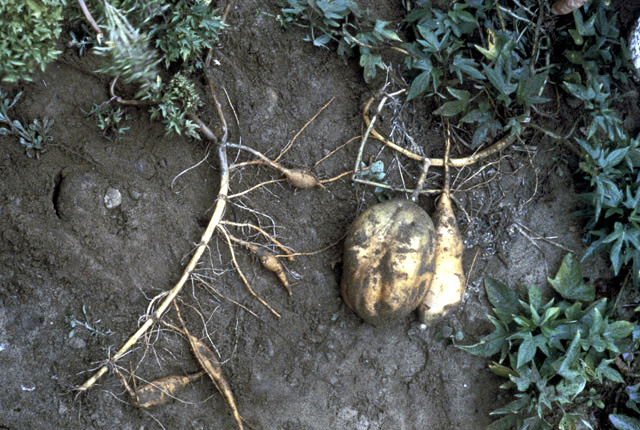
Sweet potato little leaf | Sweet potato
DISEASE: Sweet potato little leaf
HOST: Sweet potato (Ipomoea batatas)
PATHOGEN: 'Candidatus Phytoplasma aurantifolia'
PATHOGEN SYNONYM: Phytoplasma Peanut witches'-broom group
SOURCE: R. McCoy, M. Davis
DISEASE: Syringae leaf spot
HOST: Tomato
Leaves with brown necrotic lesions and chlorotic margins. Symptoms vary greatly among cultivars. Some have black or brown lesions with bright yellow, chlorotic areas and others do not have yellowing.
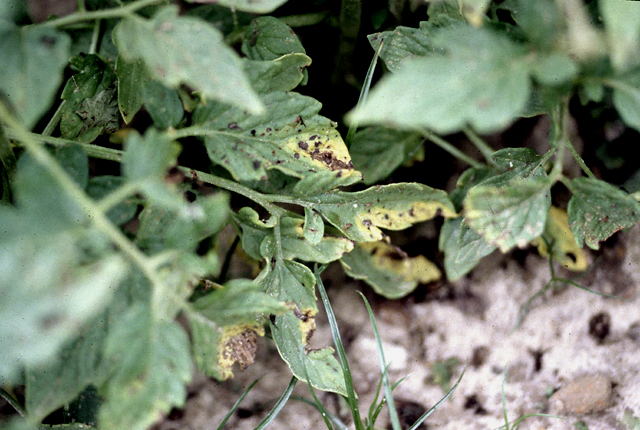
Syringae leaf spot | Tomato
DISEASE: Syringae leaf spot
HOST: Tomato (Lycopersicon esculentum)
PATHOGEN: Pseudomonas syringae pv. syringae
SOURCE: R. Gitaitis