

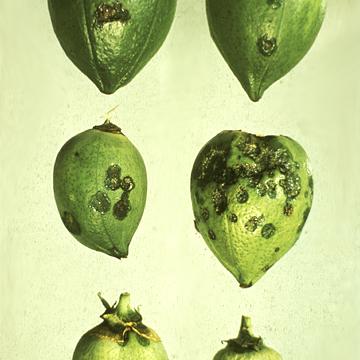
DISEASE: Bacterial blight (Boll rot)
HOST: Cotton
Boll rot first appears as raised, water-soaked lesions, which become sunken and turn brown to black with time.
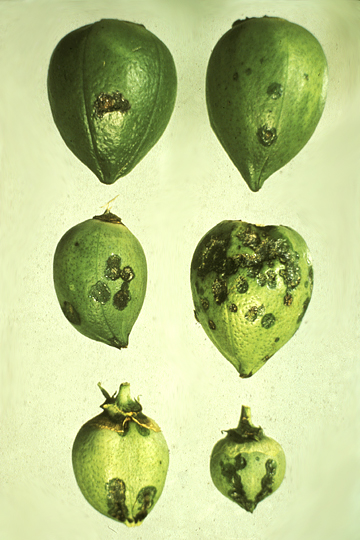
Bacterial blight (Boll rot) | Cotton
DISEASE: Bacterial blight (Boll rot)
HOST: Cotton (Gossypium barbadense)
PATHOGEN: Xanthomonas citri subsp. malvacearum
PATHOGEN SYNONYM: Xanthomonas campestris pv. malvacearum
SOURCE: A. Hayward
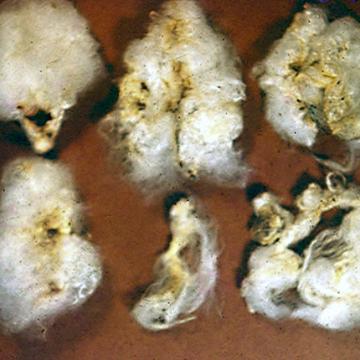
DISEASE: Bacterial blight (Boll rot)
HOST: Cotton
Infection of bolls causes premature opening and increased susceptibility to secondary, saprophytic microorganisms that cause rot. Note discolored cotton.
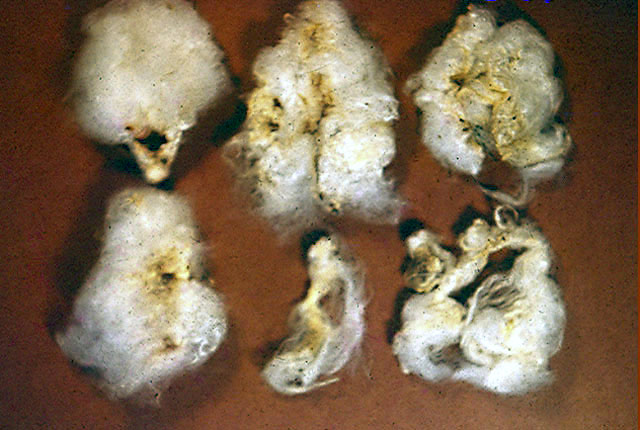
Bacterial blight (Boll rot) | Cotton
DISEASE: Bacterial blight (Boll rot)
HOST: Cotton (Gossypium barbadense)
PATHOGEN: Xanthomonas citri subsp. malvacearum
PATHOGEN SYNONYM: Xanthomonas campestris pv. malvacearum
SOURCE: APS
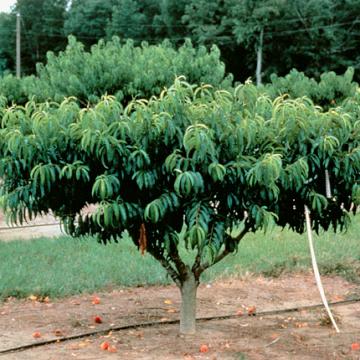
DISEASE: Phony disease (Phony peach)
HOST: Peach
Tree with characteristic reduced growth. Foliage is dark green, then turns yellowish. Twigs become brittle and branches die back. Fruit are small.
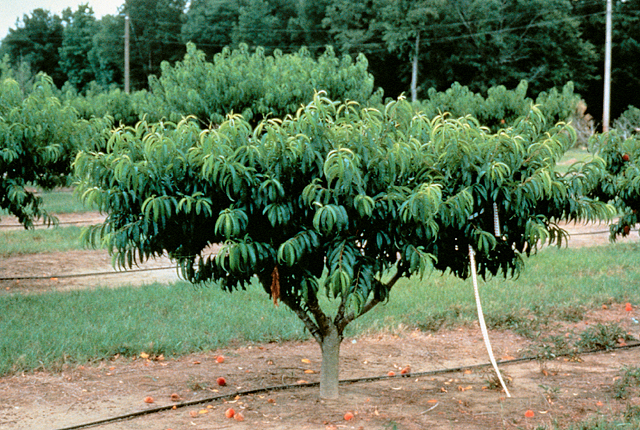
Phony disease (Phony peach) | Peach
DISEASE: Phony disease (Phony peach)
HOST: Peach (Prunus persica)
PATHOGEN: Xylella fastidiosa
SOURCE: P. C. Anderson
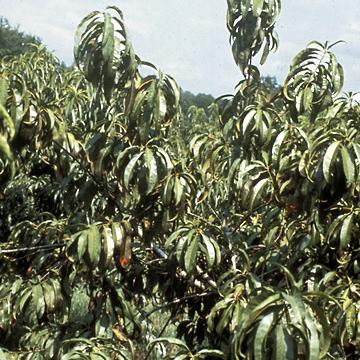
DISEASE: Phony disease (Phony peach)
HOST: Peach
Twigs on diseased trees have shortened internodes and increased lateral branching.
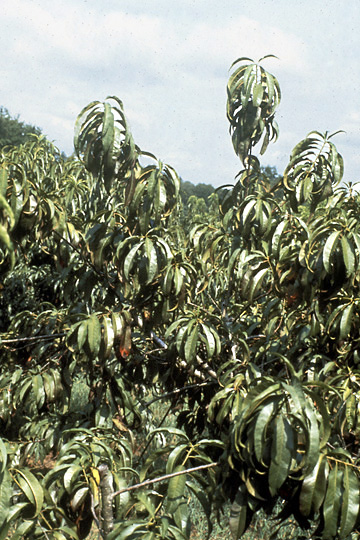
Phony disease (Phony peach) | Peach
DISEASE: Phony disease (Phony peach)
HOST: Peach (Prunus persica)
PATHOGEN: Xylella fastidiosa
SOURCE: M. Davis
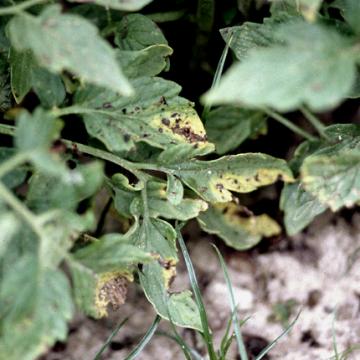
DISEASE: Syringae leaf spot
HOST: Tomato
Leaves with brown necrotic lesions and chlorotic margins. Symptoms vary greatly among cultivars. Some have black or brown lesions with bright yellow, chlorotic areas and others do not have yellowing.
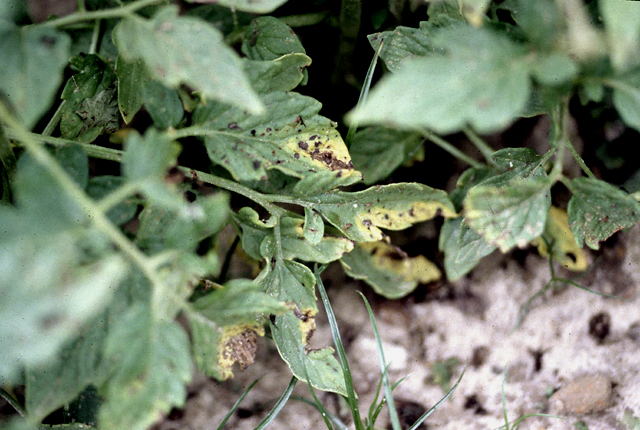
Syringae leaf spot | Tomato
DISEASE: Syringae leaf spot
HOST: Tomato (Lycopersicon esculentum)
PATHOGEN: Pseudomonas syringae pv. syringae
SOURCE: R. Gitaitis