

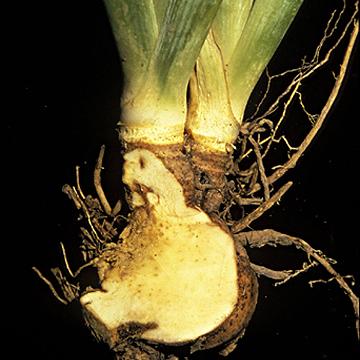
DISEASE: Bacterial stem and rhizome rot
HOST: Iris
Iris stem and rhizome with brown, discolored, rotted portions.
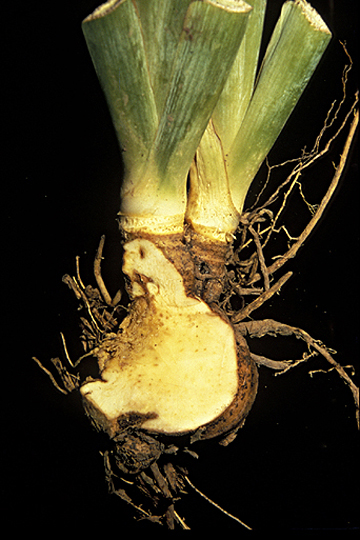
Bacterial stem and rhizome rot | Iris
DISEASE: Bacterial stem and rhizome rot
HOST: Iris (Iris sp.)
PATHOGEN: Burkholderia gladioli pv. gladioli
PATHOGEN SYNONYM: Pseudomonas gladioli pv. gladioli
SOURCE: R. Raabe
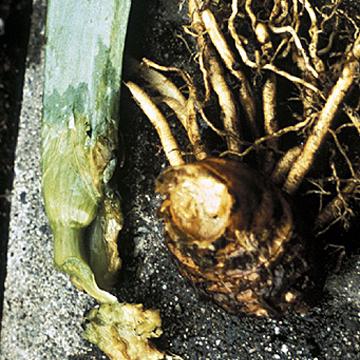
DISEASE: Bacterial stem and rhizome rot
HOST: Iris
Mushy rot of stems and rhizomes are characteristic of advanced stage of the disease.
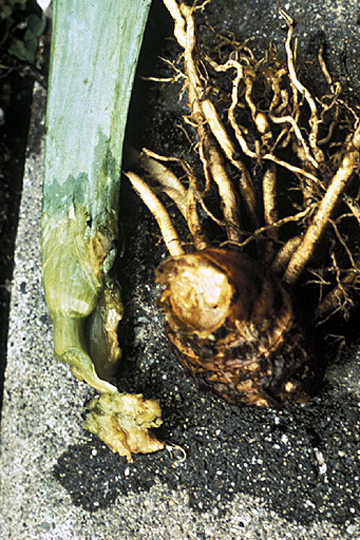
Bacterial stem and rhizome rot | Iris
DISEASE: Bacterial stem and rhizome rot
HOST: Iris (Iris sp.)
PATHOGEN: Burkholderia gladioli pv. gladioli
PATHOGEN SYNONYM: Pseudomonas gladioli pv. gladioli
SOURCE: R. Raabe
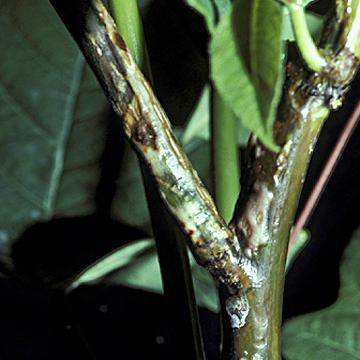
DISEASE: Greasy center
HOST: Poinsettia
Stem with dark cankers and copious ooze. Necrotic areas are greasy in appearance and eventually turn light tan to brown with a papery texture as the cuticle becomes detached.
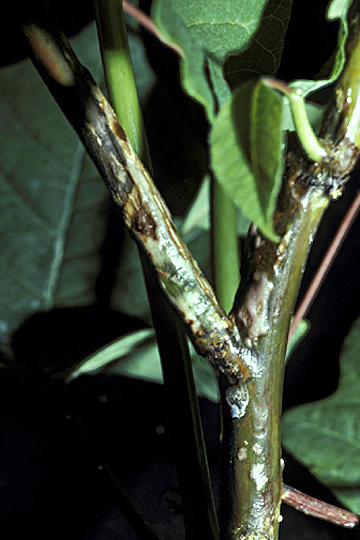
Greasy center | Poinsettia
DISEASE: Greasy center
HOST: Poinsettia (Euphorbia pulcherrima)
PATHOGEN: Pseudomonas viridiflava
SOURCE: R. Raabe
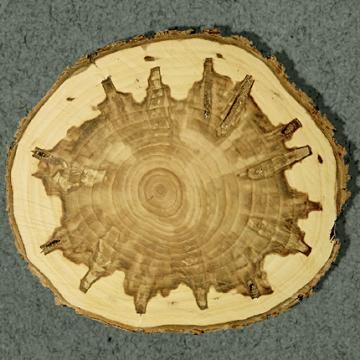
DISEASE: Western wetwood
HOST: Elm
Spokelike, discolored extensions that expanded into sapwood, following an injection with a fungicide. The causal agent is not known but symptoms are associated with bacteria and yeast.
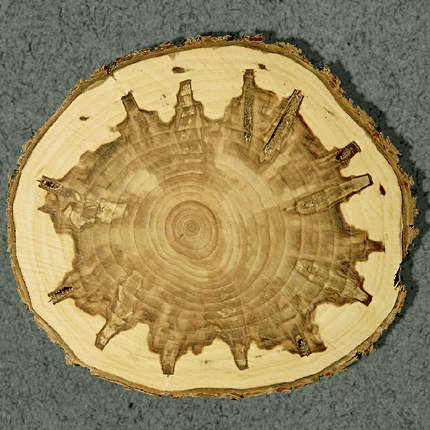
Western wetwood | Elm
DISEASE: Western wetwood
HOST: Elm (Ulmus americana)
PATHOGEN: Causal agent unknown
SOURCE: W. Sinclair