

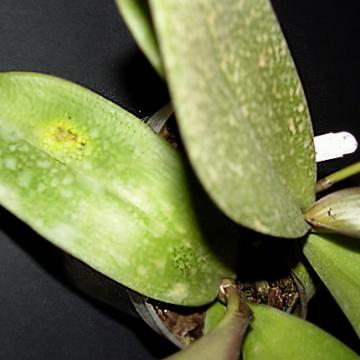
DISEASE: Bacterial brown rot
HOST: Orchid
Phalaenopsis orchid with yellowish brown spot on leaf (left), an early stage of disease.
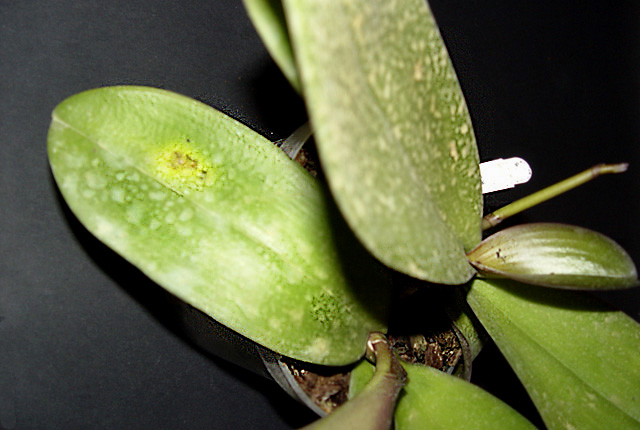
Bacterial brown rot | Orchid
DISEASE: Bacterial brown rot
HOST: Orchid (Phalaenopsis sp.)
PATHOGEN: Acidovorax cattleyae
PATHOGEN SYNONYM: Acidovorax avenae subsp. cattleyae
SOURCE: R. McMillan
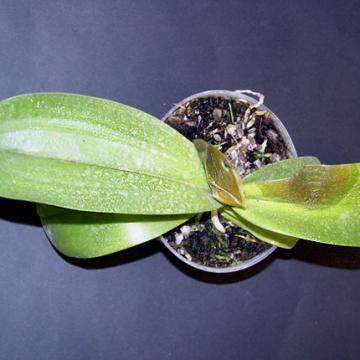
DISEASE: Bacterial brown rot
HOST: Orchid
Leaves of Phalaenopsis orchid with advanced stage of decay.
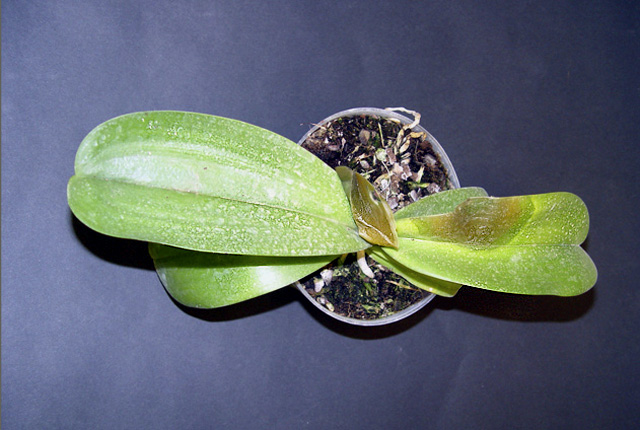
Bacterial brown rot | Orchid
DISEASE: Bacterial brown rot
HOST: Orchid (Phalaenopsis sp.)
PATHOGEN: Acidovorax cattleyae
PATHOGEN SYNONYM: Acidovorax avenae subsp. cattleyae
SOURCE: R. McMillan
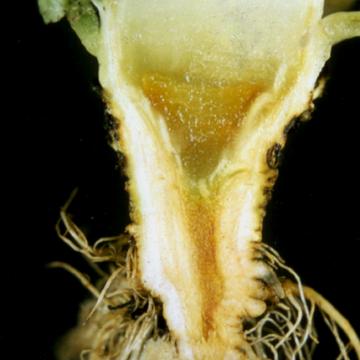
DISEASE: Head rot (Jelly rot)
HOST: Lettuce
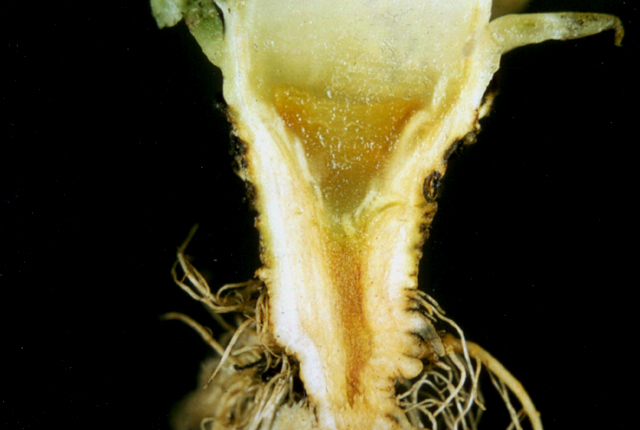
Sliced head of lettuce. Typical symptoms are a translucent appearance and browning or jelly rot of the stalk (crown).
Head rot (Jelly rot) | Lettuce
DISEASE: Head rot (Jelly rot)
HOST: Lettuce (Lactuca sativa)
PATHOGEN: Pectobacterium carotovorum
PATHOGEN SYNONYM: Erwinia carotovora subsp. carotovora
SOURCE: J. Cho, A. Alvarez
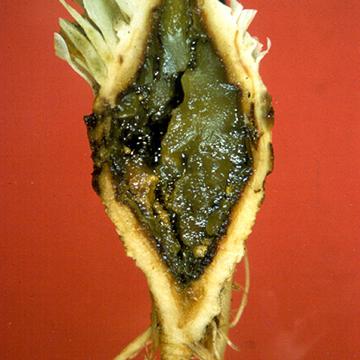
DISEASE: Head rot (Jelly rot)
HOST: Lettuce
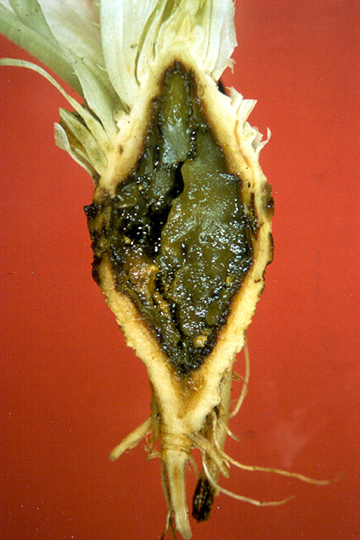
Advanced stage of lettuce stalk rot (crown).
Head rot (Jelly rot) | Lettuce
DISEASE: Head rot (Jelly rot)
HOST: Lettuce (Lactuca sativa)
PATHOGEN: Pectobacterium carotovorum
PATHOGEN SYNONYM: Erwinia carotovora subsp. carotovora
SOURCE: J. Cho, A. Alvarez
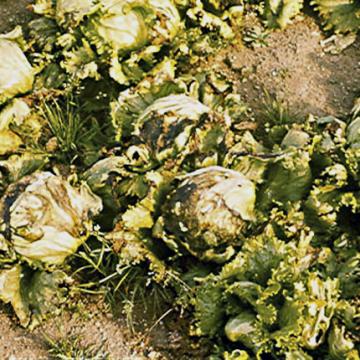
DISEASE: Head rot (Jelly rot)
HOST: Lettuce
Head rot of lettuce first appears as rapid wilt of outer wrapper leaves. Wilt is caused by collapse of vascular tissues, which develop a pinkish to brown discoloration.
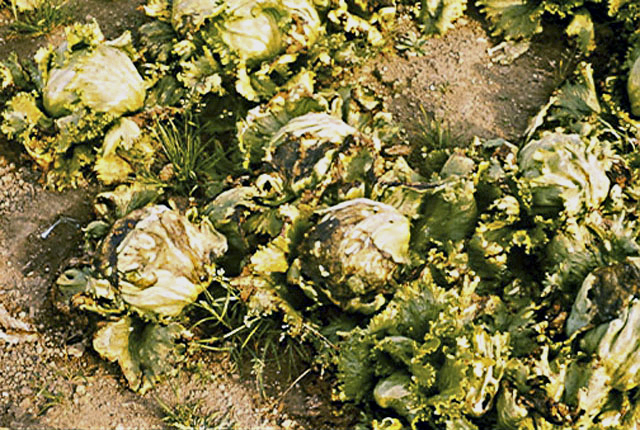
Head rot (Jelly rot) | Lettuce
DISEASE: Head rot (Jelly rot)
HOST: Lettuce (Lactuca sativa)
PATHOGEN: Pectobacterium carotovorum
PATHOGEN SYNONYM: Erwinia carotovora subsp. carotovora
SOURCE: L. Fucikovsky
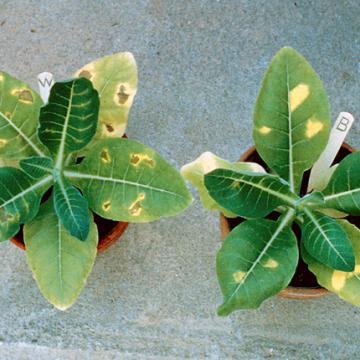
DISEASE: Wildfire (Angular leaf spot)
HOST: Tobacco
Characteristic symptoms are necrotic, brown spots with angular margins surrounded by distinct yellow halos. The halos are caused by the production of tabtoxin.
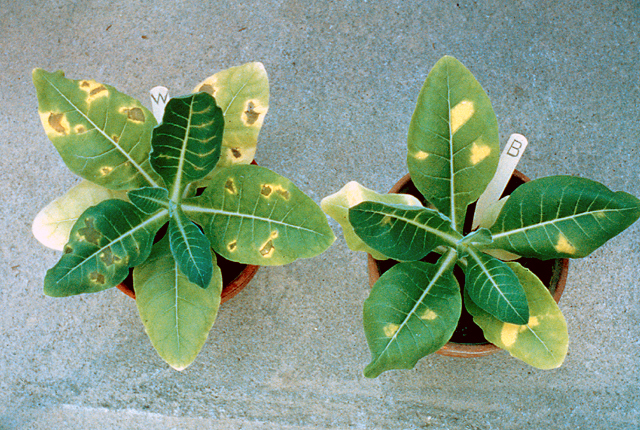
Wildfire (Angular leaf spot) | Tobacco
DISEASE: Wildfire (Angular leaf spot)
HOST: Tobacco (Nicotiana tabacum)
PATHOGEN: Pseudomonas syringae pv. tabaci
SOURCE: G. Lucas