

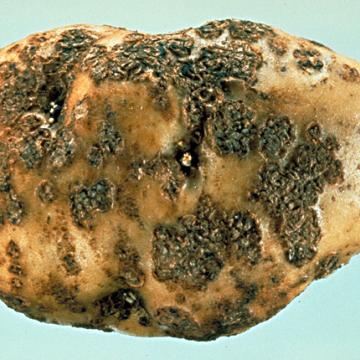
DISEASE: Common scab (Potato scab)
HOST: Potato
Symptoms of common scab vary depending upon the cultivar. The lesions can be shallow or deep, erumpent and corky, and vary in color.
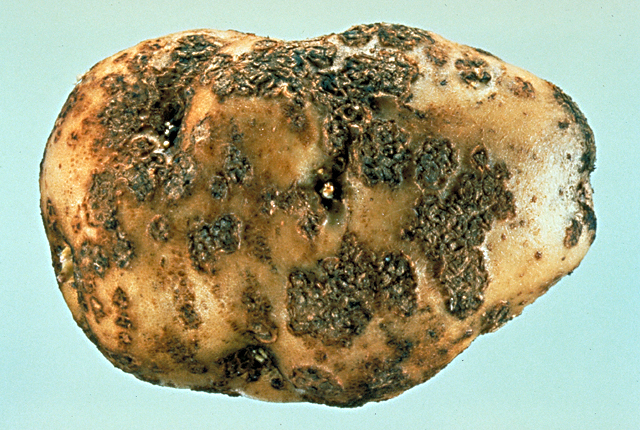
Common scab (Potato scab) | Potato
DISEASE: Common scab (Potato scab)
HOST: Potato (Solanum tuberosum)
PATHOGEN: Streptomyces scabiei
PATHOGEN SYNONYM: Streptomyces scabies
SOURCE: A. Secor
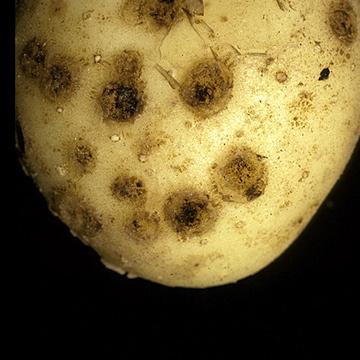
DISEASE: Common scab (Potato scab)
HOST: Potato
White-skinned tuber with sunken and superficial scab lesions.
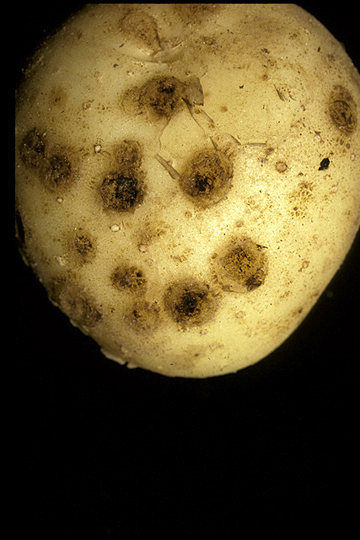
Common scab (Potato scab) | Potato
DISEASE: Common scab (Potato scab)
HOST: Potato (Solanum tuberosum)
PATHOGEN: Streptomyces scabiei
PATHOGEN SYNONYM: Streptomyces scabies
SOURCE: S. Thomson
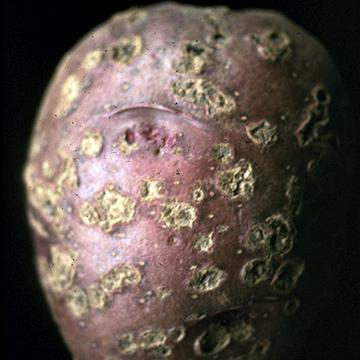
DISEASE: Common scab (Potato scab)
HOST: Potato
Red-skinned tuber with lesions that usually penetrate less than 1 mm.
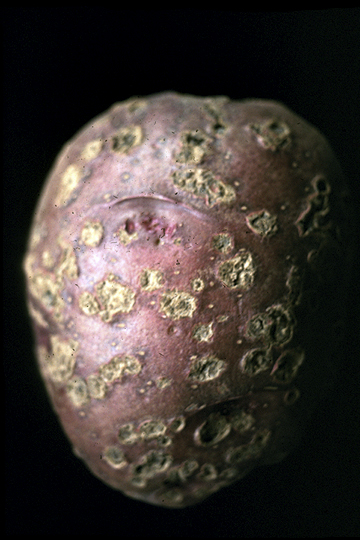
Common scab (Potato scab) | Potato
DISEASE: Common scab (Potato scab)
HOST: Potato (Solanum tuberosum)
PATHOGEN: Streptomyces scabiei
PATHOGEN SYNONYM: Streptomyces scabies
SOURCE: S. Thomson
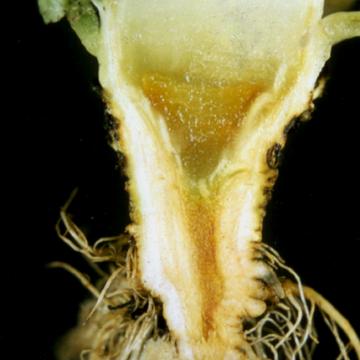
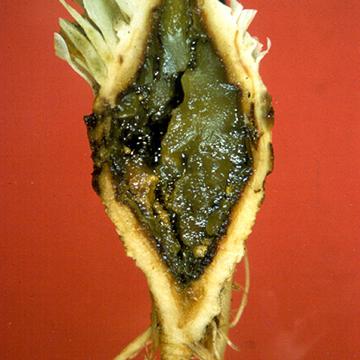
DISEASE: Head rot (Jelly rot)
HOST: Lettuce
Sliced head of lettuce. Typical symptoms are a translucent appearance and browning or jelly rot of the stalk (crown).
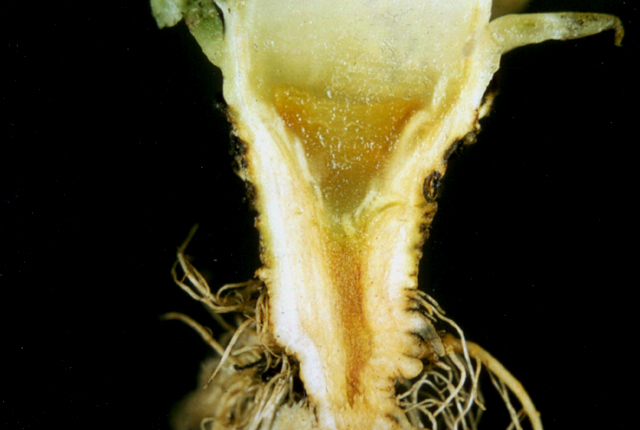
Head rot (Jelly rot) | Lettuce
DISEASE: Head rot (Jelly rot)
HOST: Lettuce (Lactuca sativa)
PATHOGEN: Pectobacterium carotovorum
PATHOGEN SYNONYM: Erwinia carotovora subsp. carotovora
SOURCE: J. Cho, A. Alvarez
DISEASE: Head rot (Jelly rot)
HOST: Lettuce
Advanced stage of lettuce stalk rot (crown).
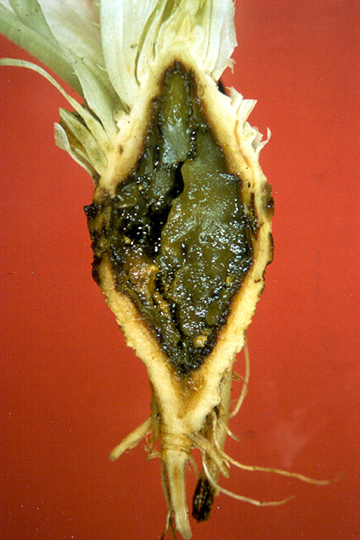
Head rot (Jelly rot) | Lettuce
DISEASE: Head rot (Jelly rot)
HOST: Lettuce (Lactuca sativa)
PATHOGEN: Pectobacterium carotovorum
PATHOGEN SYNONYM: Erwinia carotovora subsp. carotovora
SOURCE: J. Cho, A. Alvarez
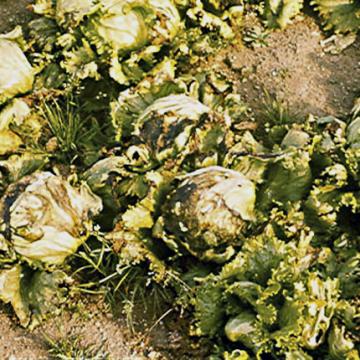
DISEASE: Head rot (Jelly rot)
HOST: Lettuce
Head rot of lettuce first appears as rapid wilt of outer wrapper leaves. Wilt is caused by collapse of vascular tissues, which develop a pinkish to brown discoloration.
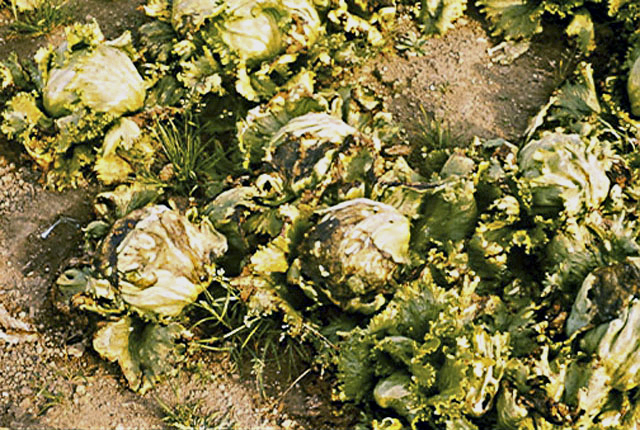
Head rot (Jelly rot) | Lettuce
DISEASE: Head rot (Jelly rot)
HOST: Lettuce (Lactuca sativa)
PATHOGEN: Pectobacterium carotovorum
PATHOGEN SYNONYM: Erwinia carotovora subsp. carotovora
SOURCE: L. Fucikovsky
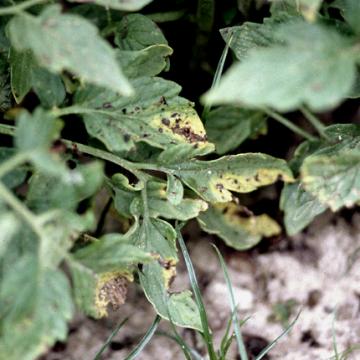
DISEASE: Syringae leaf spot
HOST: Tomato
Leaves with brown necrotic lesions and chlorotic margins. Symptoms vary greatly among cultivars. Some have black or brown lesions with bright yellow, chlorotic areas and others do not have yellowing.
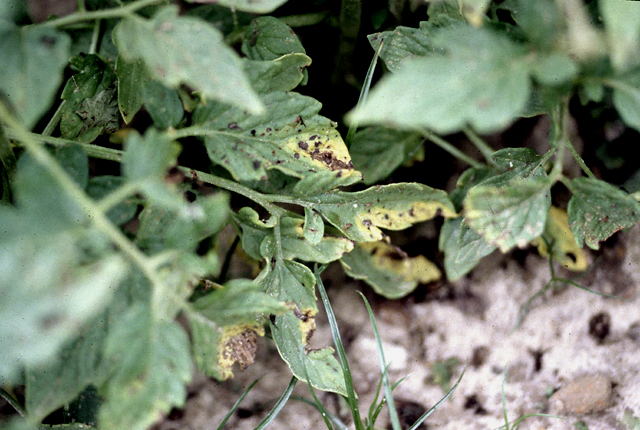
Syringae leaf spot | Tomato
DISEASE: Syringae leaf spot
HOST: Tomato (Lycopersicon esculentum)
PATHOGEN: Pseudomonas syringae pv. syringae
SOURCE: R. Gitaitis