

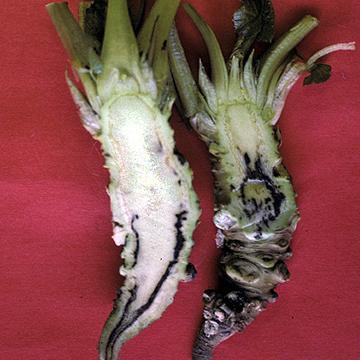
DISEASE: Bacterial soft rot
HOST: Wasabi (Japanese horseradish)
Longitudinal sections of diseased rhizomes with discolored vascular tissues.
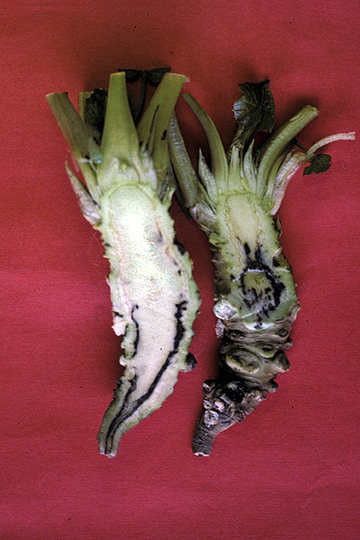
Bacterial soft rot | Wasabi (Japanese horseradish)
DISEASE: Bacterial soft rot
HOST: Wasabi (Japanese horseradish) (Wasabia japonica)
PATHOGEN: Pectobacterium wasabiae
PATHOGEN SYNONYM: Erwinia carotovora subsp. wasabiae
SOURCE: M. Goto
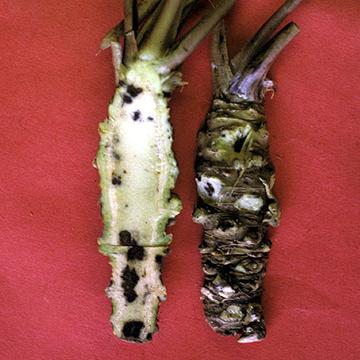
DISEASE: Bacterial soft rot
HOST: Wasabi (Japanese horseradish)
Longitudinal section of rhizome with discolored vascular bundles (left), and rhizome with external symptoms (right).
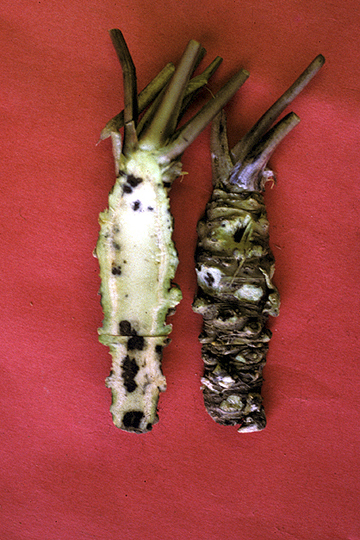
Bacterial soft rot | Wasabi (Japanese horseradish)
DISEASE: Bacterial soft rot
HOST: Wasabi (Japanese horseradish) (Wasabia japonica)
PATHOGEN: Pectobacterium wasabiae
PATHOGEN SYNONYM: Erwinia carotovora subsp. wasabiae
SOURCE: M. Goto
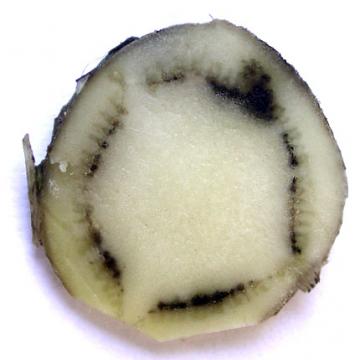
DISEASE: Bacterial soft rot
HOST: Wasabi (Japanese horseradish)
Cross section of rhizome with dark, infected vascular bundles.
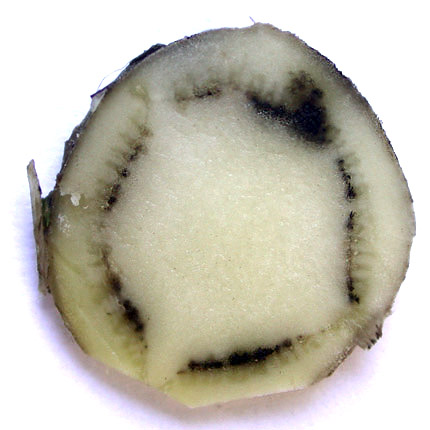
Bacterial soft rot | Wasabi (Japanese horseradish)
DISEASE: Bacterial soft rot
HOST: Wasabi (Japanese horseradish) (Wasabia japonica)
PATHOGEN: Pectobacterium wasabiae
PATHOGEN SYNONYM: Erwinia carotovora subsp. wasabiae
SOURCE: G. Rodriguez
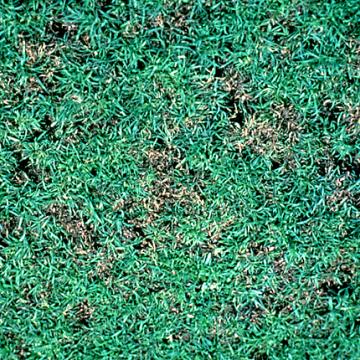
DISEASE: Bacterial wilt
HOST: Grass
Wilted and dead patches of diseased creeping bent grass (Toronto grass) on golf green.
Bacterial wilt | Grass
DISEASE: Bacterial wilt
HOST: Grass (Agrostis stolonifera)
PATHOGEN: Xanthomonas translucens pv. poae
SOURCE: D. Roberts
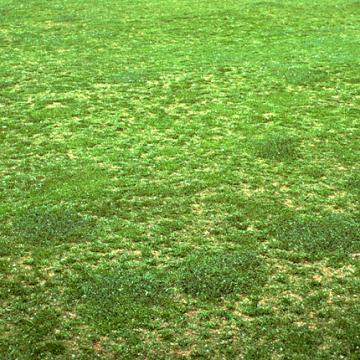
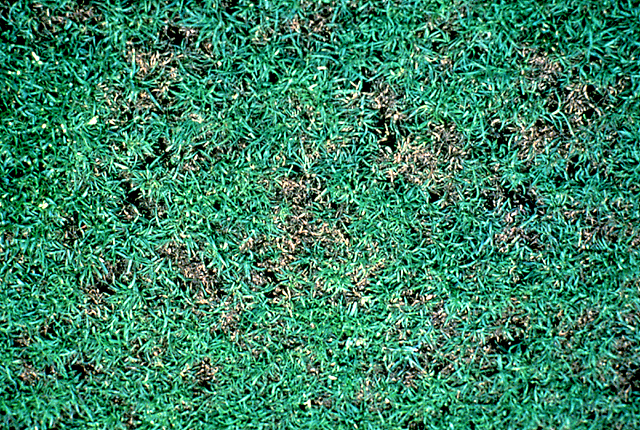
DISEASE: Bacterial wilt
HOST: Grass
Irregular disease patterns on golf green. The cultivars Toronto, Cohansey, and Nimisilia are primary hosts of the disease.
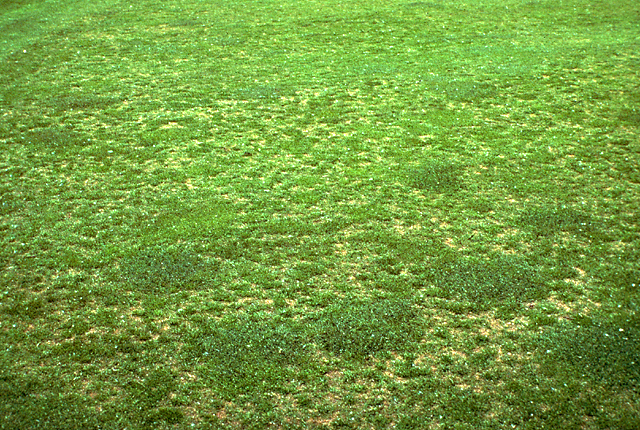
Bacterial wilt | Grass
DISEASE: Bacterial wilt
HOST: Grass (Agrostis stolonifera)
PATHOGEN: Xanthomonas translucens pv. poae
SOURCE: D. Roberts
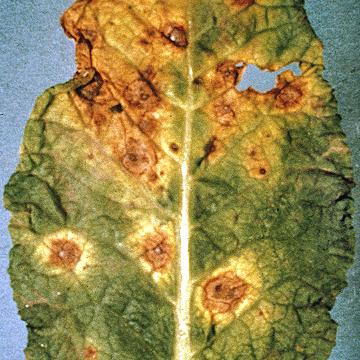
DISEASE: Pseudomonas leaf spot
HOST: Primrose
Leaf with brownish red spots and reddening of adjacent areas. Disease begins as small, water-soaked lesions that later coalesce into large necrotic spots.
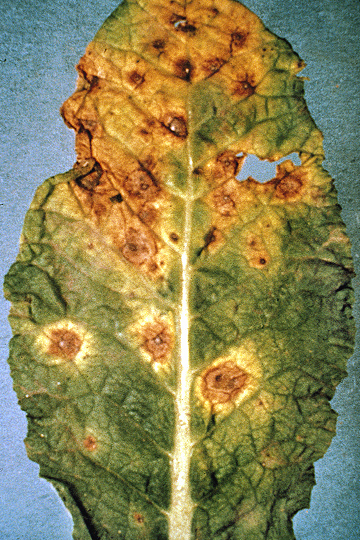
Pseudomonas leaf spot | Primrose
DISEASE: Pseudomonas leaf spot
HOST: Primrose (Primula sp.)
PATHOGEN: Pseudomonas syringae pv. primulae
SOURCE: APS