

background


Header Menu

  • VIEW NARRATIVES
Home

World Encyclopedia of Plant Bacterial Diseases

FILTER BY

clear all
clear done

FILTERS

  • Alfalfa
  • Almond
  • Aloe
  • Amaranth
  • Anthurium
  • Apple
  • Apricot
  • Armeria
  • Ash
  • Aspen
  • Aster
  • Avocado
  • Banana
  • Barley
  • Bean
  • Beet
  • Begonia
  • Bindweed
  • Bird-of-Paradise
  • Blackberry
  • Bougainvillea
  • Broccoli
  • Butternut
  • Cabbage
  • Cactus
  • Campanula
  • Candytuft
  • Canna
  • Cantaloupe
  • Carnation
  • Carrot
  • Cassava
  • Casuarina
  • Cauliflower
  • Celery
  • Chard
  • Cherry
  • Cherry laurel
  • China fir
  • Chokecherry
  • Chrysanthemum
  • Cilantro
  • Citron melon
  • Citrus (Grapefruit)
  • Citrus (Lemon)
  • Citrus (Lime)
  • Citrus (Mandarin orange)
  • Citrus (Orange)
  • Citrus (sp. unknown)
  • Clove
  • Clover
  • Coffee
  • Collard
  • Coreopsis
  • Coriander
  • Corn (Maize)
  • Cotton
  • Cowpea
  • Crabapple
  • Croton
  • Crown-of-thorns
  • Cucumber
  • Custard apple
  • Daffodil
  • Dahlia
  • Daisy
  • Datura
  • Dieffenbachia
  • Dogwood
  • Dracaena
  • Eggplant
  • Elderberry
  • Elm
  • Euonymus
  • Fennel
  • Fern
  • Ficus
  • Florida hopbush
  • Forsythia
  • Gayfeather
  • Gentian
  • Geranium
  • Ginger
  • Ginkgo
  • Gladiolus
  • (-) Grape
  • Grass
  • Gypsophila (Baby's breath)
  • Hawaiian ticktrefoil
  • Hawthorn
  • Hazelnut
  • Heliconia
  • Heron's bill (Stork's bill)
  • Hibiscus
  • Hickory
  • Horseradish
  • Hyacinth
  • Hydrangea (Oak-leaf)
  • Iris
  • Ivy
  • Kalanchoe
  • Kiwi
  • Koa
  • Konjac (Devil's tongue)
  • Kudzu
  • Larkspur
  • Laurel (California laurel)
  • Lavender
  • Lettuce
  • Lilac
  • Lily
  • Loquat
  • Magnolia
  • Mallotus
  • Mango
  • Maple
  • Marigold
  • Millet
  • Mulberry
  • Mume (Japanese apricot)
  • Mushroom
  • Muskmelon
  • Mustard
  • Nectarine
  • Nephthytis
  • Oak
  • Oat
  • Oleander
  • Olive
  • Onion
  • Orchid
  • Ornithogalum
  • Palm
  • Panax
  • Papaya
  • Parsley
  • Parsnip
  • Paulownia (Empress tree)
  • Pea
  • Peach
  • Peanut
  • Pear
  • Pecan
  • Pellionia
  • Pepper
  • Periwinkle
  • Persimmon
  • Petunia
  • Photinia
  • Pigeon pea
  • Pineapple
  • Plum
  • Pluot
  • Poinsettia
  • Poppy
  • Potato
  • Pothos
  • Primrose
  • Pumpkin
  • Radish
  • Ranunculus
  • Raspberry
  • Rhododendron
  • Rice
  • Rose
  • Rutabaga
  • Scarlet firethorn
  • Schefflera
  • Sedum
  • Sesame
  • Snapdragon
  • Sorghum
  • Soybean
  • Spathiphyllum
  • Squash
  • Stock
  • Strawberry
  • Sugarcane
  • Sweetgum
  • Sweet potato
  • Sycamore
  • Tea
  • Ti
  • Tobacco
  • (-) Tomato
  • Tulip
  • Turnip
  • Verbena
  • Viola (Horned violet)
  • Walnut
  • Wasabi (Japanese horseradish)
  • Watercress
  • Watermelon
  • Wheat
  • Wheatgrass
  • Willow
  • Wisteria (Japanese wisteria)
  • Yam bean
  • Zinnia
  • Lycopersicon esculentum
  • Vitis vinifera
  • Vitis vinifera 'Chardonnay'
  • Vitis vinifera 'Fiesta'
  • Vitis vinifera 'Pinot Noir'
  • Vitis vinifera 'Zinfandel'
  • Bacterial blight (Bacterial necrosis)
  • Bacterial canker
  • Bacterial fruit rot
  • Bacterial speck
  • Bacterial spot
  • Bacterial stem rot
  • Bacterial wilt
  • Bois noir disease
  • Crown gall
  • Pierce's disease
  • Pith necrosis
  • Syringae leaf spot
  • Tomato big bud
  • Agrobacterium vitis
  • 'Candidatus Phytoplasma asteris'
  • 'Candidatus Phytoplasma solani'
  • Clavibacter michiganensis subsp. michiganensis
  • Pectobacterium atrosepticum
  • Pseudomonas corrugata
  • Pseudomonas syringae pv. syringae
  • Pseudomonas syringae pv. tomato
  • Pseudomonas viridiflava
  • Ralstonia solanacearum
  • Xanthomonas bacterial spot pathogens
  • Xylella fastidiosa
  • Xylophilus ampelinus
Done

RESULTS

(55)
FILTER

Pagination

  • First page « First
  • Previous page ‹ Prev
  • Page 2
  • Page 3
  • Current page 4
  • Page 5
  • Page 6
  • Next page Next ›
  • Last page Last »
DISEASE: Bacterial spot
HOST: Tomato
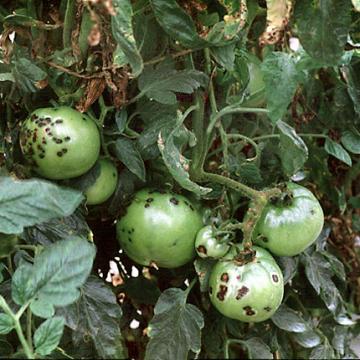
Severely infected fruit and leaves. The bacterial spot xanthomonads are Xanthomonas euvesicatoria, X. vesicatoria, X. perforans, and X. gardneri. X. perforans is not known to infect fruit.
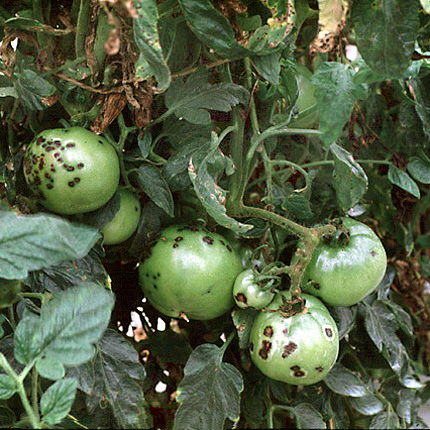
Bacterial spot | Tomato
DISEASE: Bacterial spot
HOST: Tomato (Lycopersicon esculentum)
PATHOGEN: Xanthomonas bacterial spot pathogens
PATHOGEN SYNONYM: Xanthomonas axonopodis pv. vesicatoria
SOURCE: J. Jones
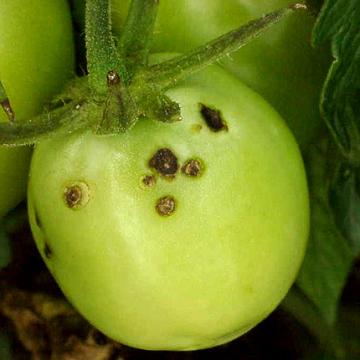
DISEASE: Bacterial spot
HOST: Tomato
Green fruit with dark brown lesions. The bacterial spot xanthomonads are Xanthomonas euvesicatoria, X. vesicatoria, X. perforans, and X. gardneri. X. perforans is not known to infect fruit.
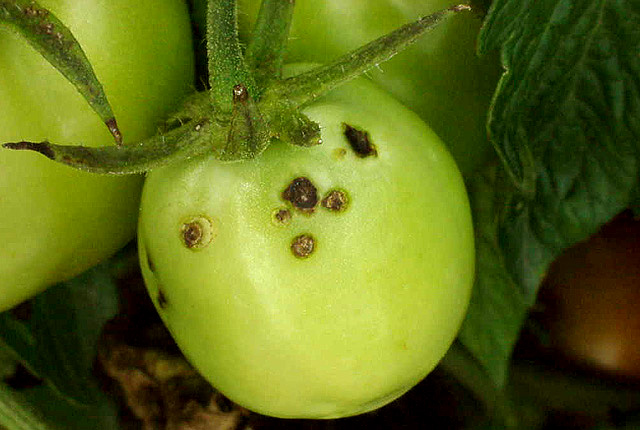
Bacterial spot | Tomato
DISEASE: Bacterial spot
HOST: Tomato (Lycopersicon esculentum)
PATHOGEN: Xanthomonas bacterial spot pathogens
PATHOGEN SYNONYM: Xanthomonas axonopodis pv. vesicatoria
SOURCE: S. Miller
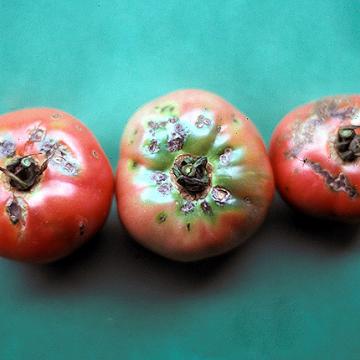
DISEASE: Bacterial spot
HOST: Tomato
Ripe fruit with dark brown spots. The bacterial spot xanthomonads are Xanthomonas euvesicatoria, X. vesicatoria, X. perforans, and X. gardneri. X. perforans is not known to infect fruit.
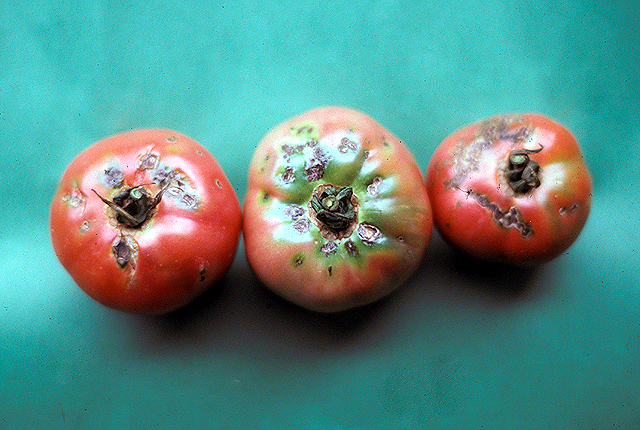
Bacterial spot | Tomato
DISEASE: Bacterial spot
HOST: Tomato (Lycopersicon esculentum)
PATHOGEN: Xanthomonas bacterial spot pathogens
PATHOGEN SYNONYM: Xanthomonas axonopodis pv. vesicatoria
SOURCE: M. Goto
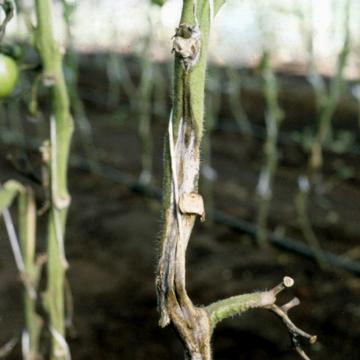
DISEASE: Bacterial stem rot
HOST: Tomato
Stem with long necrotic lesions. The pathogen often enters plants following pruning injuries.
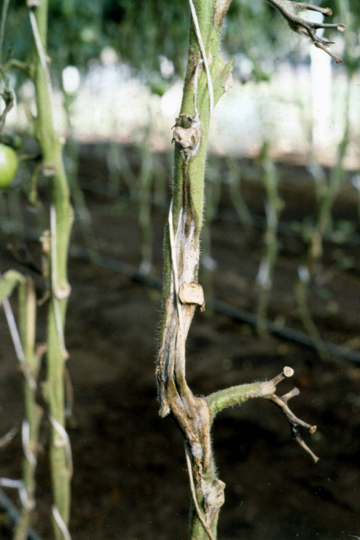
Bacterial stem rot | Tomato
DISEASE: Bacterial stem rot
HOST: Tomato (Lycopersicon esculentum)
PATHOGEN: Pectobacterium atrosepticum
PATHOGEN SYNONYM: Ewinia carotovora subsp. atroseptica
SOURCE: A. Alvarez
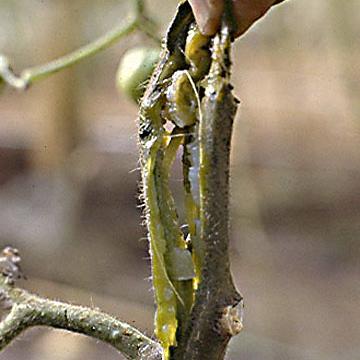
DISEASE: Bacterial stem rot
HOST: Tomato
Wilt is first symptom of disease. Later, the pith usually disintegrates, causing hollow and blackened stems.
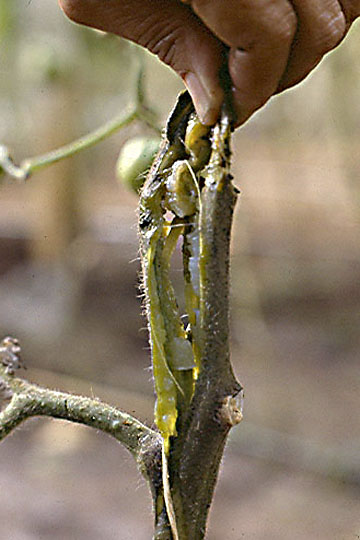
Bacterial stem rot | Tomato
DISEASE: Bacterial stem rot
HOST: Tomato (Lycopersicon esculentum)
PATHOGEN: Pectobacterium atrosepticum
PATHOGEN SYNONYM: Erwinia carotovora subsp. atroseptica
SOURCE: M. Stanghelllini
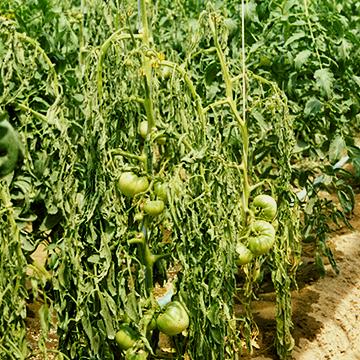
DISEASE: Bacterial wilt
HOST: Tomato
Severely infected plants in glass house. First symptoms appear as wilt of young leaves. Leaf epinasty may occur.
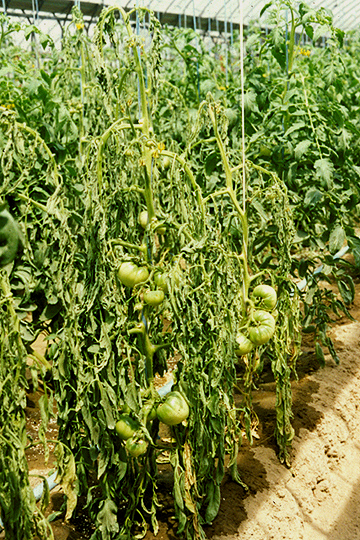
Bacterial wilt | Tomato
DISEASE: Bacterial wilt
HOST: Tomato (Lycopersicon esculentum)
PATHOGEN: Ralstonia solanacearum
PATHOGEN SYNONYM: Pseudomonas solanacearum
SOURCE: M. Goto
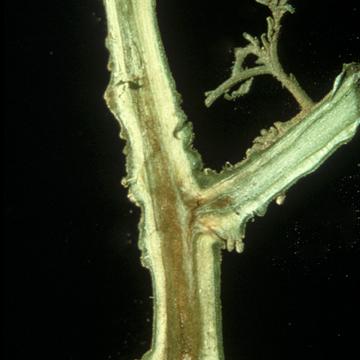
DISEASE: Bacterial wilt
HOST: Tomato
Necrotic, brownish, cortical tissues. Massive infection of cortex may result in water-soaked lesions on stem surfaces.
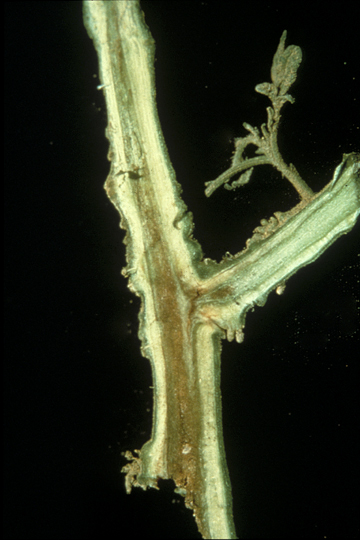
Bacterial wilt | Tomato
DISEASE: Bacterial wilt
HOST: Tomato (Lycopersicon esculentum)
PATHOGEN: Ralstonia solanacearum
PATHOGEN SYNONYM: Pseudomonas solanacearum
SOURCE: A. Hayward
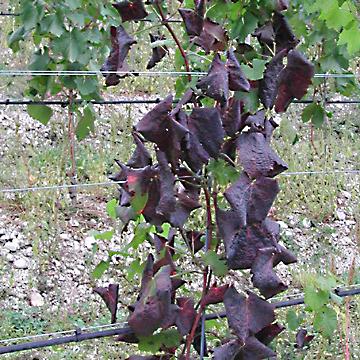
DISEASE: Bois noir disease
HOST: Grape
Severe symptoms of triangular-trapezoid-shaped leaves with desiccated appearance.
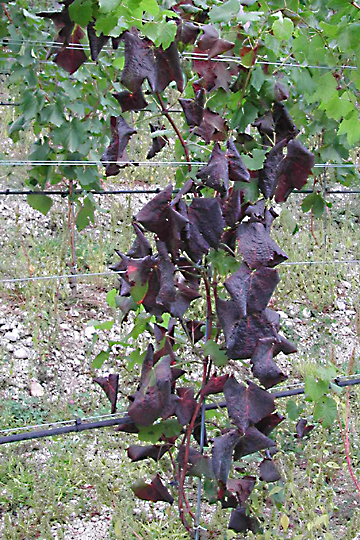
Bois noir disease | Grape
DISEASE: Bois noir disease
HOST: Grape (Vitis vinifera)
PATHOGEN: 'Candidatus Phytoplasma solani'
PATHOGEN SYNONYM: Phytoplasma Stolbur group
SOURCE: W. Schweigkofler
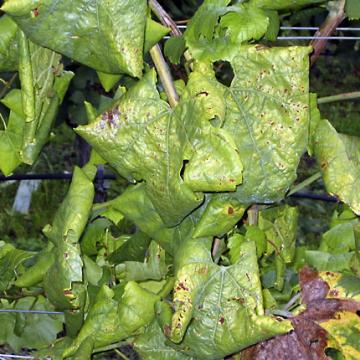
DISEASE: Bois noir disease
HOST: Grape
Leaves with disease symptoms identical to flavescence doree, a yellows disease caused by a different phytoplasma. The latter has a slightly different host range and is transmitted by a leafhopper.
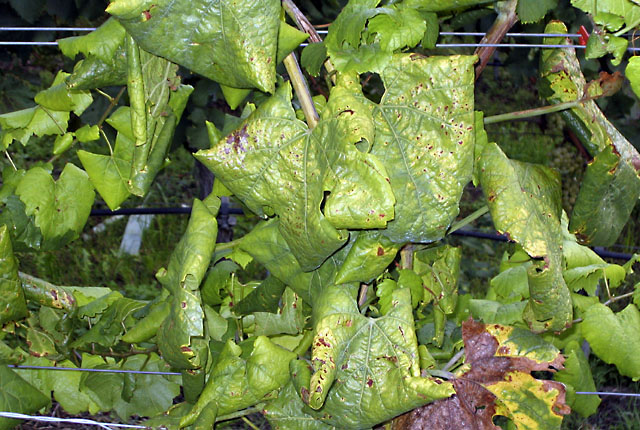
Bois noir disease | Grape
DISEASE: Bois noir disease
HOST: Grape (Vitis vinifera)
PATHOGEN: 'Candidatus Phytoplasma solani'
PATHOGEN SYNONYM: Phytoplasma Stolbur group
SOURCE: W. Schweigkofler

Pagination

  • First page « First
  • Previous page ‹ Prev
  • Page 2
  • Page 3
  • Current page 4
  • Page 5
  • Page 6
  • Next page Next ›
  • Last page Last »

Footer_Menu

  • CO-AUTHORS
  • PURPOSE
  • ACKNOWLEDGEMENTS
  • NARRATIVES
  • CONTACT
  • PRIVACY POLICY

© 2019 PlantDiseases.org. All Rights Reserved.